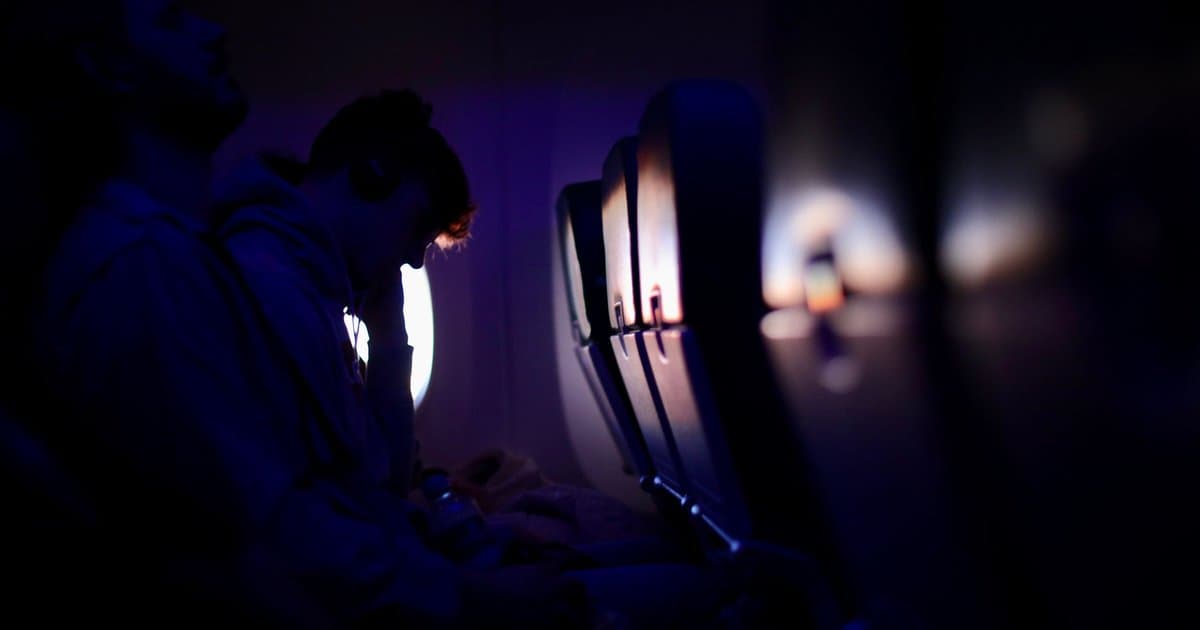
If you fly at night, you have seen this happen many times. As the plane starts its descent, a crew member walks the aisle and the cabin lights fade to a dim glow. You are asked to raise your window shade, put your seat up, and stow your tray table. It feels like routine housekeeping, the sort of thing you tune out while you dig for your headphones. Almost no one is ever told why any of it actually happens. The real reason is that these small steps are built around the few seconds that would matter most in an emergency.
Flying is remarkably safe, but the small risk it does carry is not spread out evenly. The most critical moments are the first few minutes after takeoff and the last several minutes before landing. Pilots sometimes describe it as the plus three, minus eight window, the first three minutes up and the last eight minutes down. If something is going to go wrong, it is far more likely to happen then than during smooth cruising at altitude. That is precisely why the cabin gets prepared so carefully at exactly those times. The rituals cluster around the riskiest parts of the flight for a very good reason.
The dimmed lights are the clearest example of the thinking. Your eyes need time to adjust from a bright cabin to darkness, and that shift can take many minutes to fully complete. If the lights were blazing and the plane suddenly lost power at night, you would be nearly blind in the dark for a dangerous stretch. By lowering the lights before landing, the crew lets everyone's eyes adjust ahead of time. Then, if an evacuation is needed, you can already see the aisle, the exits, and the world outside. A few minutes of dim lighting buys you working vision at the exact moment you would need it most.
The window shades follow the very same logic. You are asked to raise them so that people can see out and in during takeoff and landing. The crew needs to scan the conditions outside each side of the plane before anyone opens a door. If there is fire, debris, or water on one side, that exit should not be used, and an open shade lets them spot it in a second. Rescuers on the ground can also see into the cabin if the shades are up. Raising a plastic panel sounds trivial, but it can decide which door saves people and which one does not.
Behind all of this sits a hard standard that most passengers have never heard about. To be certified, an airliner has to prove that everyone on board can get out in 90 seconds. That test is run with half of the available exits blocked, to mimic a real emergency where some doors cannot be used. Ninety seconds is not an arbitrary number pulled out of the air. It reflects how quickly a survivable situation can turn deadly, often from smoke and fire rather than the impact itself. Every cabin rule you follow is designed to protect that narrow 90-second margin.
This is why the seat backs, tray tables, and bags matter far more than they seem. In an evacuation, people need to move toward the exits without tripping or squeezing past obstacles. A reclined seat narrows the space for the person seated right behind you. A tray table left down is a hard barrier across your own lap. A bag in the aisle is something a panicked crowd will stumble over in the dark. Putting everything back in its place clears a path that could carry a full plane out in well under two minutes.
A couple of other details work quietly in the background of every flight. The little strip of lights running along the floor is not decoration, it is a lighted path that leads to the exits when the cabin is dark or full of smoke. The brace position shown on the safety card is designed to reduce injury on impact so you are able to stand and move afterward. Neither of these gets much attention during a calm, ordinary flight. Both of them exist for the same narrow window of time. They are what turn a survivable event into one that people actually walk away from.
The point of understanding this is not to make you nervous the next time you fly. The odds of ever needing any of it are very small, and that is worth holding onto. But the rules are not busywork invented to annoy travelers on a long day. Each one is a lesson written after real accidents, aimed at the handful of seconds when preparation and survival meet. Following them costs you nothing and asks almost no effort at all. Doing them on purpose, instead of on autopilot, is a quiet way of taking your own safety seriously.