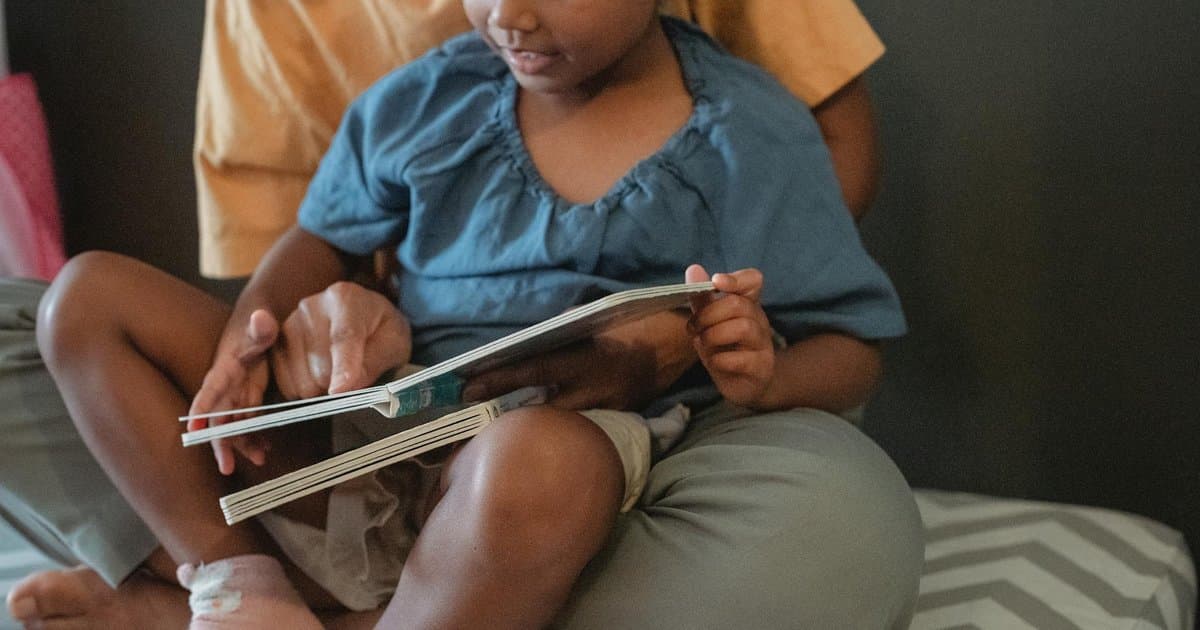
Most parents stop reading aloud to their kids around age 8. The logic seems reasonable. By third grade most children can read independently. Bedtime stories feel like something you do for preschoolers, and the kid is already doing 20 minutes of school assigned reading every day. Why duplicate the effort. The problem is that the research on this is unusually clear, and it points in the opposite direction. The kids who get read to past third grade gain vocabulary, comprehension, and reading stamina at a rate that almost no other intervention matches. The kids who stop fall behind quietly, and the gap shows up most when the work gets harder in fifth and sixth grade.
The reason has to do with how vocabulary actually builds. A child reading independently at grade level encounters most of the same words over and over. The words that drive academic vocabulary, the ones that show up on tests and in textbooks, sit two to three grade levels above what the child can read on their own. Those words live inside slightly harder books. When a parent reads aloud, the child can follow a story that is two years above their own reading level because the parent is doing the decoding work. A 2019 study from Ohio State University estimated that children read to daily through age 10 hear about 1.4 million more words by kindergarten than children who are not, and the gap keeps widening. The numbers compound through elementary school.
There is a comprehension piece on top of that. Independent reading is mostly silent. The brain processes the words but does not always slow down to make sense of them. Reading aloud forces a pause. The reader hits punctuation, changes voice for dialogue, asks a clarifying question. The child builds a mental model of how stories work, and that mental model carries over into their independent reading. Teachers report that children who are still being read to at home ask better questions, summarize chapters more accurately, and infer character motivation faster. Those skills are what separates strong middle school readers from struggling ones, and they are not easy to teach in a classroom of 24.
The habit also does something that does not show up in test scores. It creates a low pressure space where the child can ask about anything. The book brings up a topic, and the child has 15 minutes to talk about it with a parent who is not asking about homework or behavior. Educators at Harvard Graduate School of Education have studied this for years. They consistently find that the kids who keep being read to into middle school report stronger connections with the reading parent, and those connections show up later as resilience during academically harder seasons. The book is a vehicle, but the real thing being built is conversation.
The setup is not complicated. Pick a book one or two grade levels above the child's reading level. Read 15 to 20 minutes a night, ideally at the same time so it becomes a default. Stop to ask one or two questions per chapter, not every page. Let the child pick most of the books, because ownership matters more than literary quality. Series work well because momentum carries the habit. Many parents find that the kid who said they hated reading at age 9 starts asking for the next chapter at age 11, because the routine made the experience feel different from the school version of reading.
The mistake is treating reading aloud as something you graduate from. The American Academy of Pediatrics and the National Education Association both recommend continuing through at least sixth grade for that reason. Twenty minutes a day, five days a week, for three years, is roughly 250 hours of additional language exposure. There is no tutor, no app, and no enrichment program that delivers the same return for free. Most parents stop because the kid stops asking, not because the kid stops needing it. Keep doing it anyway. The version of your child who hits middle school will thank you for it.
Book selection matters more than most parents realize. Pick narratives with strong dialogue, complex characters, and at least some unfamiliar settings. Classic chapter books like the Harry Potter series, the Chronicles of Narnia, A Wrinkle in Time, and the Percy Jackson series check those boxes for most middle elementary readers. For older kids, biographies, sports memoirs, and books tied to topics they already care about work well. Avoid the temptation to push purely educational books. The goal is to keep them in the chair, not to maximize information density per page. A child who looks forward to the next chapter is doing the actual work without realizing it, which is the entire point.