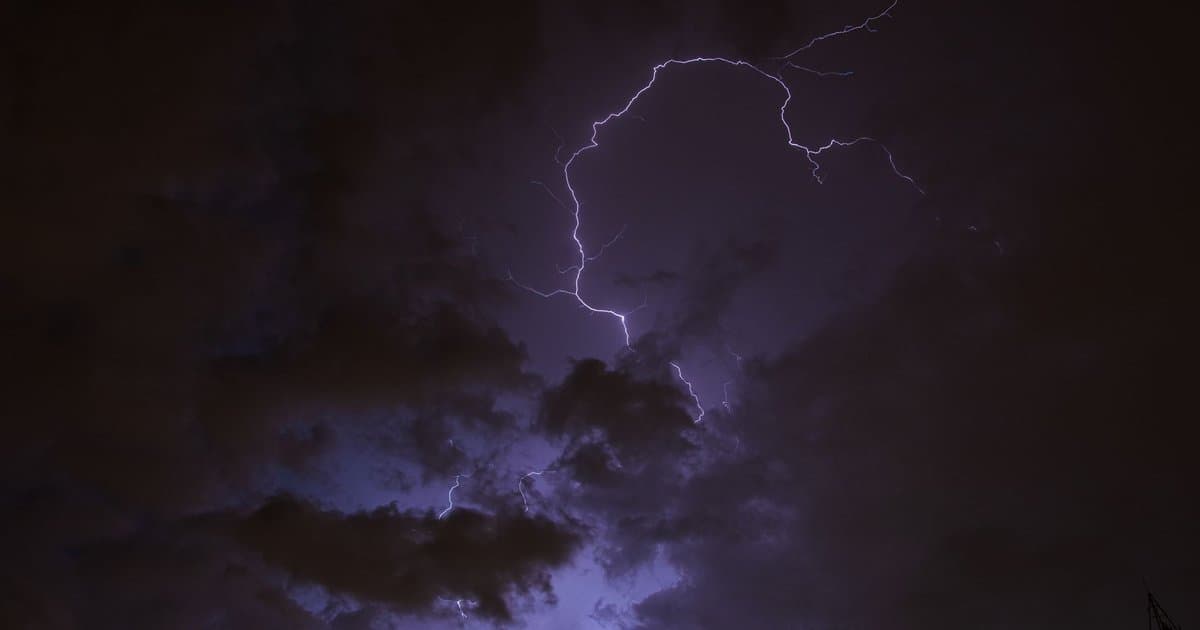
Here is a fact that sounds made up until you check it. A single bolt of lightning can heat the air around it to about 53,540 degrees Fahrenheit. The visible surface of the sun sits near 10,340 degrees Fahrenheit. That means the flash you see during a summer storm is roughly five times hotter than the face of the star that lights our entire solar system. It lasts only a fraction of a second, but for that instant it is one of the hottest things you will ever stand near. Most of us grew up fearing lightning without ever knowing just how extreme it really is.
The comparison does need one honest note. Lightning is hotter than the surface of the sun, not the whole sun. The part of the sun we actually see, called the photosphere, is the outer layer that glows. Deeper inside, the core runs to millions of degrees from the nuclear reactions that power it. So the sun as a whole still wins by a wide margin. What lightning beats is the bright skin of the sun, the layer that gives us daylight and warmth, and beating that is impressive enough.
So why does a bolt of electricity get so blisteringly hot? The answer is resistance. Air is a poor conductor, which means it fights hard against any electricity trying to pass through it. When a lightning channel forces a massive current through that stubborn air in a few millionths of a second, the energy has nowhere to go but into heat. The air cannot spread that heat fast enough, so the temperature spikes to tens of thousands of degrees almost instantly. The same principle explains why a wire can warm up when current runs through it, only lightning does it at a scale that is hard to imagine.
You might wonder how anyone measures the heat of something that vanishes in a blink. Scientists do not stick a thermometer in a storm. Instead they study the light itself using a tool called a spectrometer, which spreads the flash into its individual colors. The exact mix of colors reveals how hot the glowing air had to be to shine that way. This method, called spectroscopy, is the same basic trick astronomers use to measure the temperature of distant stars. From the safety of the ground, researchers can read a bolt like a fingerprint and calculate its heat with real confidence.
That intense heat is also the reason thunder exists. When the channel of air superheats in an instant, it expands with explosive force, faster than the speed of sound. That sudden expansion sends out a shockwave, and the shockwave reaches your ears as a crack or a long rolling boom. Thunder and lightning happen at the same moment, but light travels far faster than sound, so you see the flash first. If you count the seconds between the flash and the boom, every five seconds means the strike was about one mile away. That simple count has helped people gauge storms for generations.
The numbers behind a bolt are just as startling as the temperature. A typical lightning strike carries a current of around 30,000 amperes, thousands of times more than the wiring in your home ever handles. The main flash you notice is often a series of strokes firing so quickly that your eye blends them into one flicker. The whole event usually finishes in less than a second. In that short window it releases enough energy to power a house for weeks, though we have no practical way to catch and store it. All of that force is packed into a channel only a few centimeters wide.
Knowing how powerful lightning is should change how you treat a storm. The safest rule is simple. When thunder roars, go indoors, and stay there until the storm has clearly passed. If you can hear thunder at all, you are already close enough to be struck, since bolts can leap several miles from the cloud that made them. Open fields, water, and tall lonely trees are among the worst places to be. A closed building or a hard topped vehicle offers far better protection than most people assume. Waiting an extra half hour after the last rumble is a small price for real safety.
It is easy to treat lightning as background noise during a rainy afternoon. The truth is that each flash is a brief visit from something hotter than the surface of our own star. The next time a storm rolls through, you can watch it with a little more respect and a lot more understanding. You are seeing air pushed to a temperature no oven or furnace on earth can reach. It arrives, it cracks the sky, and it is gone before you can blink. Few everyday sights hide that much raw power.