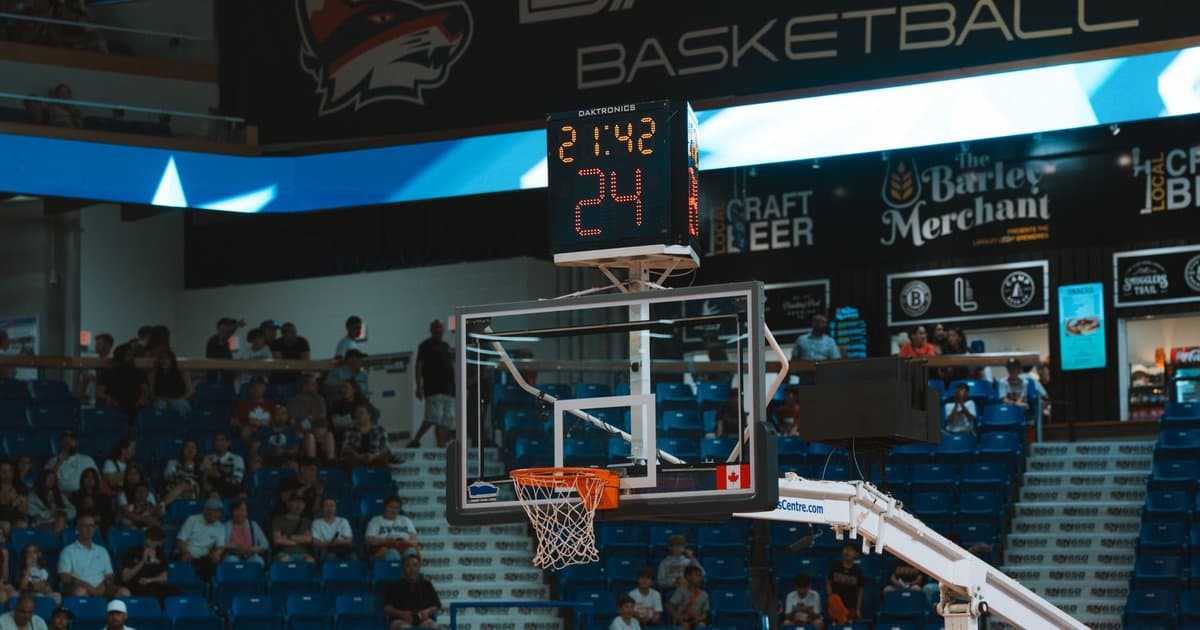
Basketball moves fast, and a big reason is a small clock most fans barely notice. Every time a team gets the ball, a countdown starts from twenty four seconds. The team has to attempt a shot that hits the rim before that clock runs out. If they fail, they lose the ball to the other side. It sounds like a minor rule, but it shapes the entire pace of the game. Without it, the sport would look almost nothing like what we watch today. The story of where the number came from is one of the best in sports. It starts with a game so ugly it nearly killed the league.
In the early 1950s, professional basketball had a serious problem. There was no clock forcing teams to shoot, so a team with a lead could simply hold the ball. Players would dribble and pass in circles, daring the other side to foul them. Games turned into slow, boring standoffs with very little scoring. The low point came in November of 1950, in a game between Fort Wayne and Minneapolis. The final score was nineteen to eighteen, the lowest in league history. Fans hated it, and the sport was losing crowds fast. Something had to change, or professional basketball was going to fade out.
The fix came from a man who owned a struggling team. Danny Biasone ran the Syracuse Nationals and was tired of watching the game stall. He believed the answer was a clock that forced action, but he needed the right number. Too short and the game would feel rushed and sloppy. Too long and teams would still find ways to waste time. He wanted a limit that matched how a good, active game already flowed. So he sat down and did some simple math. That math is why the number is twenty four and not twenty or thirty.
Biasone looked at games that felt fast and fun to watch. He noticed that in those games, the two teams took about one hundred and twenty shots in total. A full game lasts forty eight minutes, which works out to two thousand eight hundred and eighty seconds. He divided that total time by the one hundred and twenty shots. The answer came out to exactly twenty four seconds per shot. It was not a guess or a round number picked for looks. It was a real average pulled from the games people actually enjoyed. He simply turned that pattern into a rule.
The clock arrived for the nineteen fifty four season, and the effect was instant. Scoring jumped right away as teams were forced to push the ball and shoot. Games got faster, higher scoring, and far more fun to watch. Crowds came back, and the league steadied itself after years of trouble. The change worked so well that it is now seen as one of the most important rules in the sport. Nearly every level of basketball uses some version of a shot clock today. The number varies a little in college and other leagues, but the idea is the same. One man's arithmetic reshaped how the game is played everywhere.
There is a lesson in that number that reaches past basketball. A hard limit can actually free people to do their best work. When teams could stall forever, they played it safe and dull. When the clock gave them just twenty four seconds, they had to move, create, and take chances. The pressure did not ruin the game, it made the game. Deadlines often work the same way in ordinary life and work. A little urgency can turn slow, cautious effort into something sharp and alive. The right constraint is not a cage, it is a push.