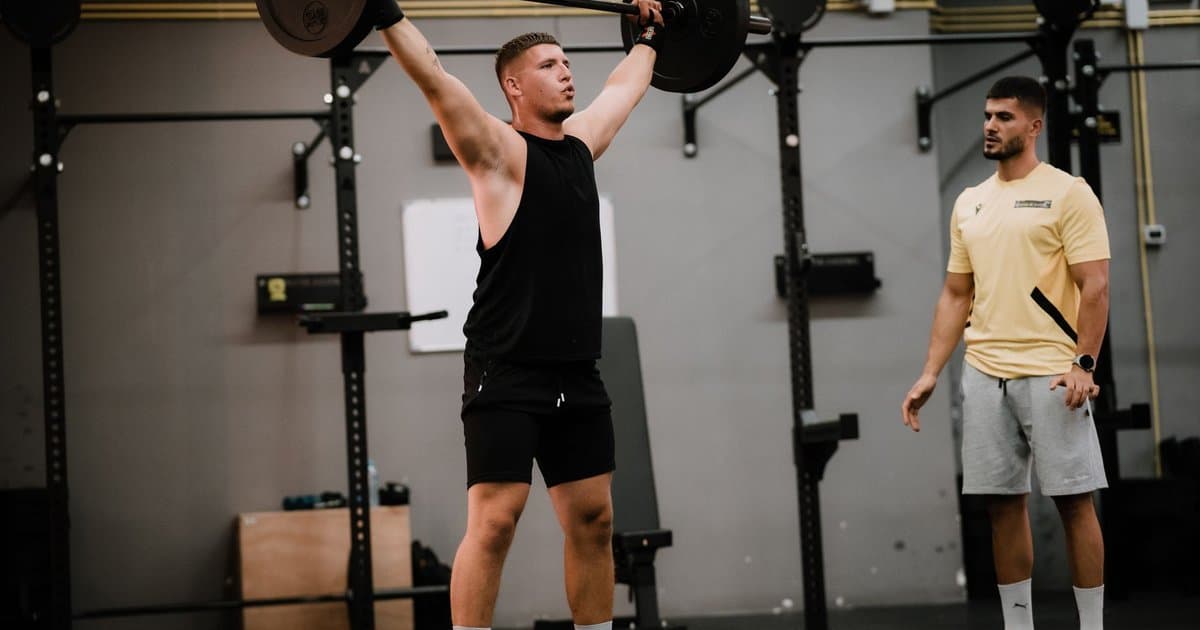
Most of us learned to stretch before a workout when we were kids. A coach lined everyone up, you reached down for your toes, you held it while somebody counted, and then you went and ran. The logic felt airtight. Loosen the muscle first and you protect it from harm. For decades that was the standard rule in gyms, on tracks, and on every field in the country. Almost nobody stopped to ask whether it actually worked. When researchers finally put it to the test, the answer surprised a lot of people who had built their whole routine around it.
The kind of stretching most people do before training has a name. It is called static stretching, and it means holding a muscle in a lengthened position for twenty or thirty seconds without moving. Study after study has shown that doing this right before you lift or sprint can lower your strength and power for a short window afterward. The drop is usually small, often just a few percent, but it is real and it shows up again and again in the data. For a competitive athlete chasing a personal record, a few percent is the whole game. For a regular person it means the warm-up may be quietly working against the exact thing they showed up to do.
The injury piece is where the real shock lands. The entire reason we were told to stretch was to avoid pulls, strains, and tweaks. Large reviews that pool together many studies have not found that static stretching before exercise lowers injury risk in any meaningful way. The one job it was assigned, it does not actually do. That does not make stretching worthless as a practice. It means the timing was wrong and the promise attached to it was never backed by solid evidence. People repeated the claim so often that it started to feel like a law of nature.
So if the toe-touch is not protecting you, what does. A warm-up that raises your body temperature and takes your joints through their full range of motion does far more. This approach is called a dynamic warm-up, and it looks like movement instead of holding still. Think leg swings, walking lunges, arm circles, and lighter versions of whatever you are about to do. You are telling your nervous system and your muscles what is coming next. Blood flow climbs, the joints get slippery, and your body shifts up into a working gear. That is the preparation that actually carries over into the session.
The reason static stretching backfires is worth understanding, because it makes the fix obvious. When you hold a long stretch, you briefly reduce the muscle's ability to produce force. Part of that effect is mechanical, in the tissue itself, and part of it is neural, in the signal your brain sends. Your body dials the volume down for a few minutes. That is completely fine when the goal is to cool down or to build flexibility on its own terms. It is the opposite of what you want in the final seconds before you ask a muscle to fire as hard as it can. The stretch is not bad. It is just badly timed.
None of this means flexibility does not matter, because it clearly does. Moving well through a full range of motion keeps you healthy and mobile across an entire lifetime. The correction is simple and it costs you nothing. Do your static stretching after the workout, or on a separate day, when the goal is length rather than power. Yoga, mobility drills, and long slow holds all have a real place in a strong routine. The problem was never the stretch itself. The problem was jamming it into the one slot where it does the least good.
There is a bigger lesson buried in here about how fitness advice spreads and sticks. A tip gets repeated enough times that it turns into a habit nobody thinks to question. Coaches teach what their coaches taught them, and the chain runs back further than anyone can trace. The pre-run toe-touch survived for generations on tradition alone, not on a single strong study. When scientists finally ran the experiments, the old rule simply did not hold up. This pattern shows up across the whole fitness world more often than people would like to admit.
So here is something you can use the very next time you train. Before you start, warm up by moving your body, not by holding a stretch and waiting. Save the long holds for after your session, when they help instead of hurt. Your first few reps will feel stronger and steadier, and you will not be handing away power for a stretch that was never guarding you in the first place. Your body responds to what you actually do, not to what a faded poster on the gym wall told you back in the nineties. Give it two weeks and pay honest attention to how your sessions start to feel.