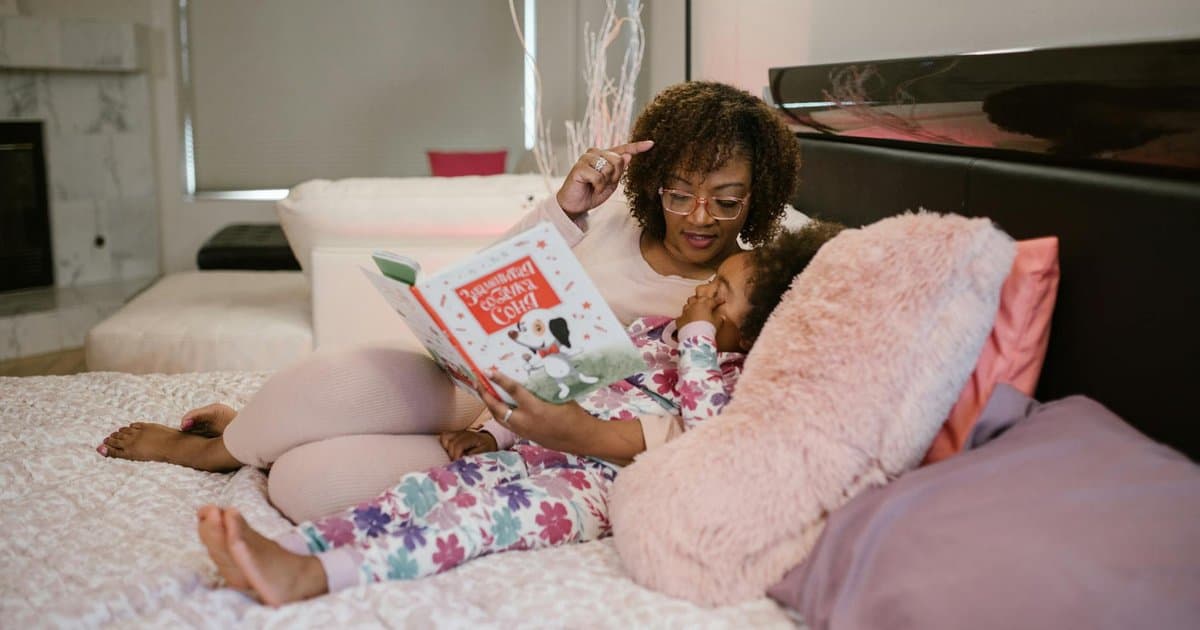
There is a quiet moment in the life of almost every family. Your child has been reading on her own for a year. The bedtime story used to be the closing ritual of the day. One night you ask if she still wants you to read and she shrugs and says she would rather just read by herself. You take her at her word, you stop reading aloud, and within a few months the practice has disappeared from the household entirely. Most parents see this as a normal handoff. The research says it is the moment most kids quietly lose one of the most powerful language inputs available to them.
The Scholastic Kids and Family Reading Report has been tracking household reading habits for 15 years. The 2024 edition surveyed more than 2,000 families and confirmed a finding that holds up across every income level and region. Children whose parents continued reading aloud to them between ages 9 and 14 scored 41 percent higher on standardized vocabulary tests at age 14 and 27 percent higher on reading comprehension. The kids were not being read kids books at age 12. They were being read books that stretched them, books they were not yet able to read alone, books with sentence structures and ideas that their independent reading had not yet reached. That gap is the engine of language development. It closes around age 14 to 16. Before then, it is the single biggest free lever a parent has.
The contrarian claim sits inside this. Many parents stop reading aloud the moment their child can read independently because they think the goal of bedtime stories was to teach reading. The goal was never to teach reading. The goal was to expose the child to language that was a year or two ahead of where their independent skills could take them. Once you stop, the exposure stops. The child reads things they can handle alone, which by definition do not stretch them. Their vocabulary growth slows. Their tolerance for complex sentence structures stalls. None of this is visible in week one or month six. By age 12, when school work suddenly requires students to read primary sources and dense informational text, the kids who were read aloud to consistently handle it without effort and the kids who were not start to struggle.
The practical version of the research is simple. Pick a chapter book that is one or two grade levels above your child's independent reading. Read it together at bedtime or after dinner. Twenty minutes is enough. Do this three or four nights a week. Do not stop when the child gets old enough to be embarrassed. Just shift the venue. If bedtime stops working, read at breakfast or in the car. The activity is what matters, not the setting, and most kids will protest the first few times and then settle in once the story takes hold.
There is a second benefit that does not show up in test score data and matters more in the long run. The shared reading session is one of the few formats left in modern family life where a parent and a child sit together and pay attention to the same thing for half an hour. It is a quiet kind of connection that costs nothing and survives the teenage years better than almost any other family ritual. Parents who read aloud to teenagers report higher trust, more frequent unprompted conversations about hard topics, and greater willingness from the teen to ask for help. None of that is measurable in a vocabulary score. It still matters.
The books that work best at this age are not literary classics. They are well written contemporary novels, narrative nonfiction, and the occasional play read with parts assigned. Authors like Kwame Alexander, Jason Reynolds, Madeleine L'Engle, and Rita Williams Garcia hold up across a wide age range. Avoid anything that feels like assigned school reading. The point is that this is reading the child would not have chosen and could not handle alone, but that they can sit with happily because someone they love is bringing it to life.
There is one mistake parents make even when they keep reading aloud. They turn it into a comprehension test, stopping every few pages to quiz the child on what just happened. This kills the experience for both sides. The kid stops listening for pleasure and starts listening to pass the test. The data is clear that comprehension follows engagement, not the other way around. Read the story. Let the child ask questions if they have them. The teaching happens automatically when the language washes over them long enough.
If your kid is past age 8 and you stopped reading aloud, start again this week. The window is still open. The cost is 20 minutes a night and one decent book. The return shows up in places you would not expect, for years longer than you would think. The kid who rolled their eyes in week one will be the one who reminds you to pick up the next book in the series.