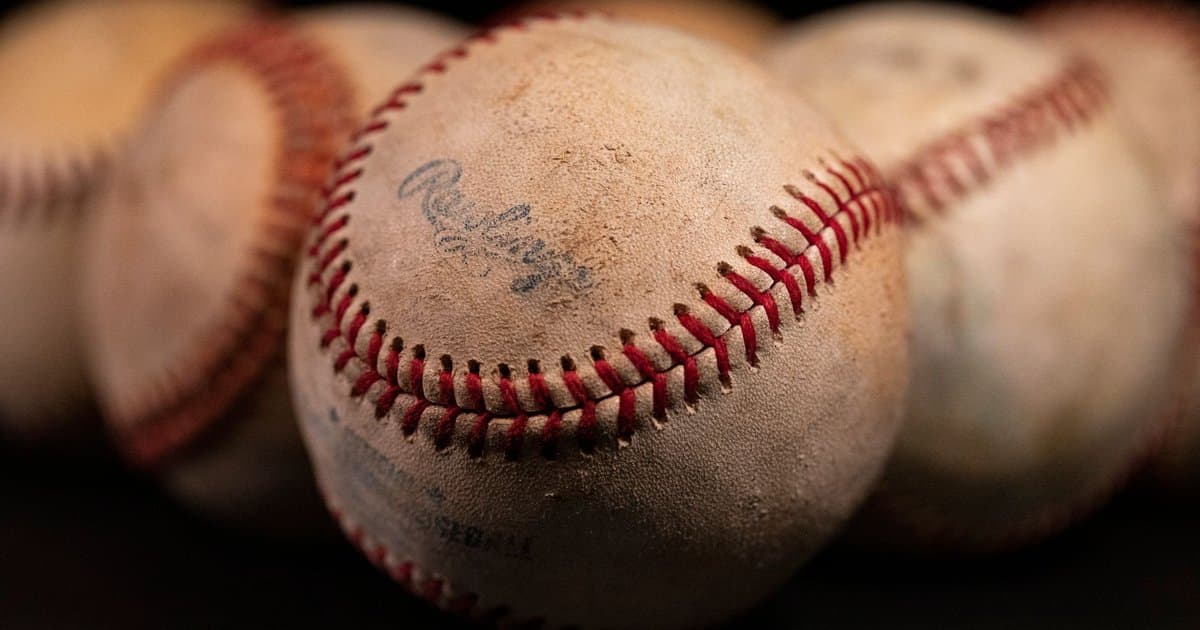
Pick up a baseball and run your thumb across the red seams. Those raised stitches are not there for looks, and the count is not an accident. A regulation ball used in the major leagues has exactly 108 double stitches, sewn with red waxed thread. That number stays the same from one ball to the next, because the game depends on it being consistent. What most fans never realize is that a machine does not sew those stitches. A person does, by hand, one ball at a time.
The ball itself is built in layers before anyone touches a needle. At the center sits a small core called the pill, which is a cork sphere wrapped in two thin layers of rubber. Around that core, workers wind three separate layers of wool yarn, then a final layer of a poly and cotton blend. Wool is used because it springs back to shape, which helps the ball keep its size and bounce through hard use. All of that gets wrapped in two pieces of cowhide cut in a figure eight shape. Until 1974, the cover was horsehide, which is where the old nickname came from.
Then comes the hand work. A stitcher takes the two cowhide panels, wets them so they stretch, and sews them together with a long red thread. It takes about 108 stitches to close the cover, and the first and last stitches are tucked out of sight so the ball looks clean. A skilled worker needs somewhere around 10 to 15 minutes to finish a single ball. The thread is pulled tight by hand, which is why the seams stand up the way they do. That raised ridge is the whole point of the design.
Most major league baseballs are made in one place, a factory in Turrialba, Costa Rica, run by Rawlings. Workers there stitch millions of balls a year, and the skill takes months to learn well. Machines can wind the yarn and cut the leather, but no machine has matched a human hand for the final stitching. The tension has to be even, and the seams have to sit just right, or the ball will not behave the way pitchers expect. So a sport built on billion dollar contracts still rests on careful hand sewing. That is a strange and wonderful fact about the game.
The seams are not decoration, and this is where the 108 stitches earn their keep. When a pitcher grips the ball, the fingers ride on those raised seams. The way the seams catch the air decides how the ball moves on its way to the plate. A four seam fastball is held so that four rows of stitching spin into the wind, which keeps the pitch straight and fast. A two seam grip lets the ball run and sink instead of flying straight. Small changes in grip lead to very different pitches.
Breaking pitches take this even further. A curveball works because the pitcher spins the ball hard, and the seams grab the air to pull the pitch down and away. A slider, a cutter, and a splitter all use the seams in slightly different ways to bend the flight. Without those raised stitches, a pitcher could barely make the ball do anything at all. The same seams that a stitcher pulled tight by hand become the tool that fools a hitter. Ninety feet away, a batter has a fraction of a second to read that spin.
The stitches also explain why baseballs get swapped out so often. A single ball might stay in play for only a few pitches before an umpire tosses it aside. Scuffs and dirt change how the seams grip the air, and even a small mark can give a pitcher an unfair edge. Teams go through many dozens of balls in a single game, and the league uses hundreds of thousands across a season. Each one of those balls carries the same 108 stitches. Each one passed through a person's hands first.
So the count is not trivia for its own sake. It is the reason the game looks the way it does, from a blazing fastball to a curve that falls off the table. The next time a pitch dives at the last moment, you are watching air push against 108 hand sewn stitches. A machine could never quite get it right, so people still do the work. It is one of the last corners of pro sports where the human hand still decides the outcome. That little red thread is doing more than you think.