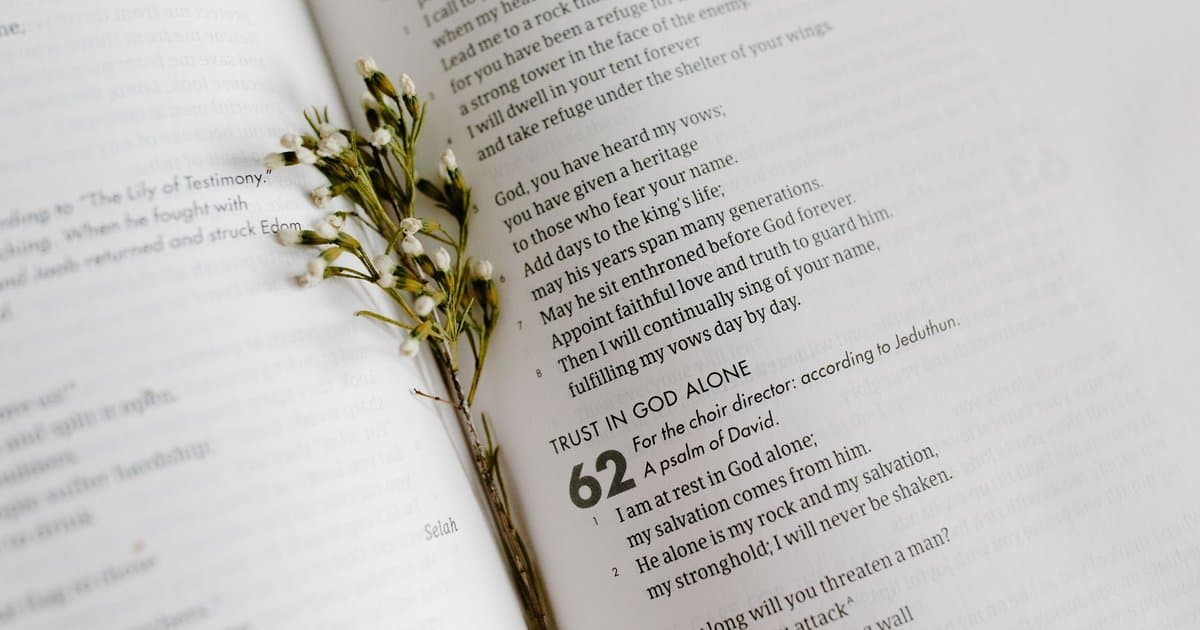
Open the book of Psalms and read for a while, and you will keep bumping into a strange little word. It sits at the end of a line, set apart, saying Selah, and most people read right past it as if it were a printing mark. It shows up more than seventy times in the Psalms and a few times elsewhere, so it is not rare or accidental. For a word that appears that often, it is remarkable how little attention it gets from ordinary readers. Part of the reason is that it does not seem to fit the sentence, so the eye simply skips it. But the people who first sang these songs would not have skipped it, and understanding why changes how you read.
The first honest thing to say is that no one knows for certain what Selah means. It is one of the genuine puzzles in the Hebrew text, and careful scholars admit the meaning is uncertain. The word was likely a direction connected to how the Psalms were performed as music in worship, and its exact sense was lost over the centuries. That uncertainty is not a reason to ignore it, it is a reason to slow down and pay attention. When an ancient text keeps a word that even the experts cannot fully translate, that word is worth sitting with. The mystery is part of the invitation, not a flaw to skip over.
The most common and most useful theory is that Selah marks a pause. On this reading, it is a signal to stop, to let the line that came before it sink in before moving on. Picture a singer holding silence for a moment so the weight of the words can settle over everyone listening. It works a little like a rest in a piece of music, where the silence is doing real work, not just filling space. If that is what Selah means, then it is an instruction to breathe, to reflect, and to refuse to rush. That alone would make it one of the most practical words in the whole book. A single moment of held silence can do more for a heavy line than another verse of explanation ever could. The pause is not empty, it is the space where the meaning finally catches up to the words.
Other theories point in directions that are just as rich. Some connect Selah to a Hebrew root meaning to lift up, which could mean lifting the voices, lifting the instruments, or lifting the words toward God. On that reading it is a swell rather than a silence, a moment where the music rises instead of resting. Others treat it as a purely technical note for the musicians, a cue about volume, or a change in the arrangement. These readings do not cancel each other out, and the truth may hold more than one of them at once. Whether it means pause or lift, the word marks a moment that mattered enough to preserve.
Here is the part worth carrying with you. Whatever the precise translation, Selah marks a deliberate break in the flow of worship. That is a striking idea in a world that treats stopping as wasted time. The Psalms were the songbook of a people learning to speak honestly to God, about joy, anger, grief, and hope. Building pauses into those songs suggests that reflection was not optional but part of the design. The text itself is telling you that some words are too heavy to read at full speed.
Reading the Psalms with Selah in mind can change the experience. The next time you reach one, try actually stopping instead of gliding past. Read the line that came right before it a second time, and ask what it is really saying. Sit in the silence for a breath or two, the way the first singers may have done. You will often find that the line before a Selah is a claim worth weighing, a turn in the prayer, or a truth the writer wanted to underline. The word becomes a small hand on your shoulder, telling you not to hurry through something important. Read this way, a psalm stops being a page to finish and becomes a place to linger. The pauses turn reading into something much closer to listening.
It is a strange comfort that a word we cannot fully translate can still teach us so much. Selah reminds us that worship was never meant to be a race to the end of the page. It builds stillness into a text that most of us read too fast, and it does so on purpose. In a life that rewards speed and constant motion, a built in instruction to pause is worth more than a clean definition ever would be. You do not have to solve the puzzle to obey the invitation. The next time you see it, stop, breathe, and let the words do their work.