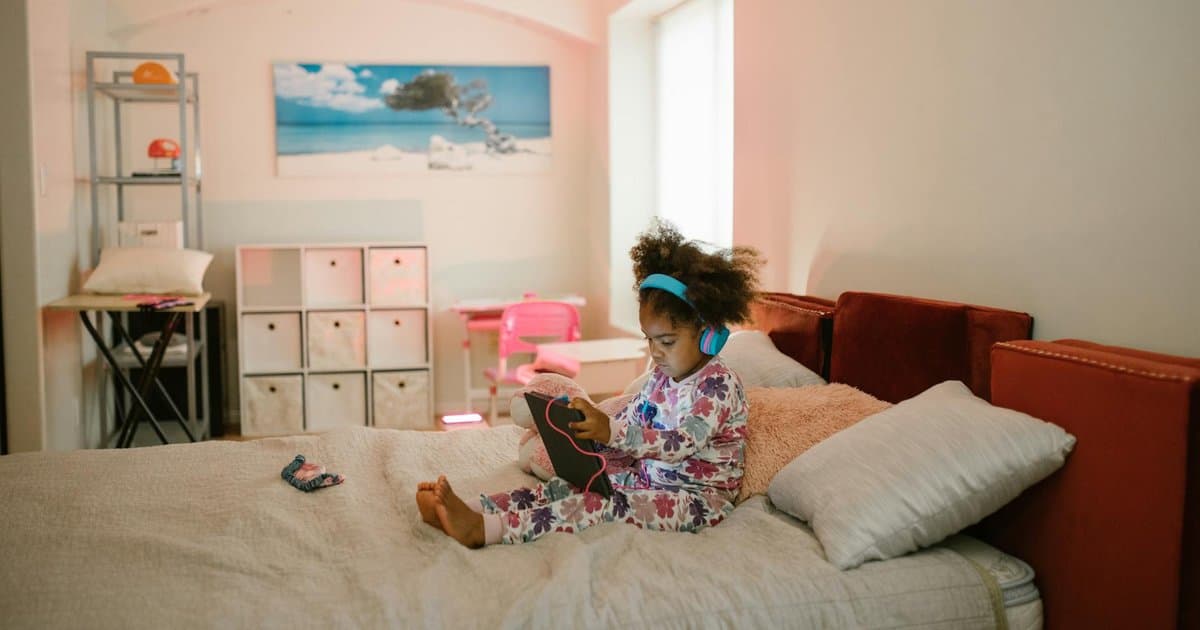
A tablet or phone at bedtime feels like a small mercy after a long day, a way to keep a child calm while you finish the dishes and wind things down. Plenty of parents hand over a device for the last half hour before sleep and assume it does no real harm. What actually happens inside a child's body during that half hour tells a different story. Screens at bedtime interfere with sleep through several mechanisms at once, and the effects show up the next morning in mood, focus, and behavior. The bedtime device is not neutral. It quietly trades a quieter evening for a harder night and a rougher day after.
The most discussed culprit is light, specifically the blue-toned light that screens emit. That light suppresses melatonin, the hormone that signals the brain it is time to sleep, and it does so most strongly in the evening hours. A child staring at a bright screen up close is telling their brain that it is still daytime, which pushes back the natural drift toward sleep. The result is that they take longer to fall asleep even after the device is gone. Younger children appear especially sensitive to this effect, since their developing eyes let more light through. The glow that looks soothing to a parent is working against the very sleep they are trying to encourage.
Light is only part of the problem, because content matters as much as the screen itself. Games, videos, and social apps are engineered to hold attention, which is the opposite of what a winding-down brain needs. A fast-paced video or an exciting game raises arousal and alertness right when a child should be calming down. Even content that seems gentle can carry a cliffhanger or a notification that pulls the mind back in. The device does not respect bedtime, and a young child has almost no ability to self-regulate against a system built by adults to be hard to put down. Stimulation at the wrong hour delays sleep regardless of how dim the screen is set.
The lost sleep is not a small thing, because sleep is where a child's brain and body do essential work. During deep sleep, the brain consolidates what was learned that day, and the body releases growth hormone and repairs itself. A child who loses thirty to sixty minutes of sleep a night to screens accumulates a deficit that compounds over a week. That deficit shows up as irritability, trouble focusing in school, and the kind of emotional volatility that parents often mistake for a behavior problem. Tired children do not act tired the way adults do. They often act wired, defiant, and overwhelmed, which makes the real cause easy to miss.
There is also a habit-forming dimension that outlasts any single night. When a device becomes the tool a child uses to fall asleep, they can lose the ability to settle themselves without it. Sleep associations formed in early childhood tend to stick, and a child who needs a screen to drift off may carry that dependence for years. Breaking the pattern later is harder than never building it. The bedtime tablet can quietly become a crutch that the whole household then has to work to remove. What started as a convenience becomes a nightly negotiation.
The fix is less painful than parents fear, though it asks for some consistency. Most sleep experts suggest powering down screens at least thirty to sixty minutes before bed and keeping devices out of the bedroom overnight. Replacing the screen with a predictable wind-down routine, a bath, a book, dim lights, and a little conversation, gives the brain the calm signals it was missing. Charging devices in a common room rather than the child's room removes the temptation entirely and protects sleep from late-night scrolling. The first few nights may bring resistance, since any routine change does, but the new pattern usually settles within a week or two. Children adapt faster than adults expect.
The reveal here is that the bedtime screen is not the harmless babysitter it appears to be. It delays sleep through light, stimulates a brain that should be settling, steals the rest that drives mood and learning, and can build a dependence that lingers. None of that means screens are evil or that a parent who hands one over has failed. It means the timing is the issue, and the last hour of the day is the worst possible window. Move the screens earlier, guard the bedroom, and protect the wind-down. The change costs a parent some short-term friction and a little creativity in filling that last hour before bed. What it returns is a child who falls asleep faster, sleeps more deeply, and wakes up easier to be around. Those are not small wins on a busy weekday morning when everyone is already stretched thin. The quieter evening you give up buys back a calmer, sharper child the next morning.