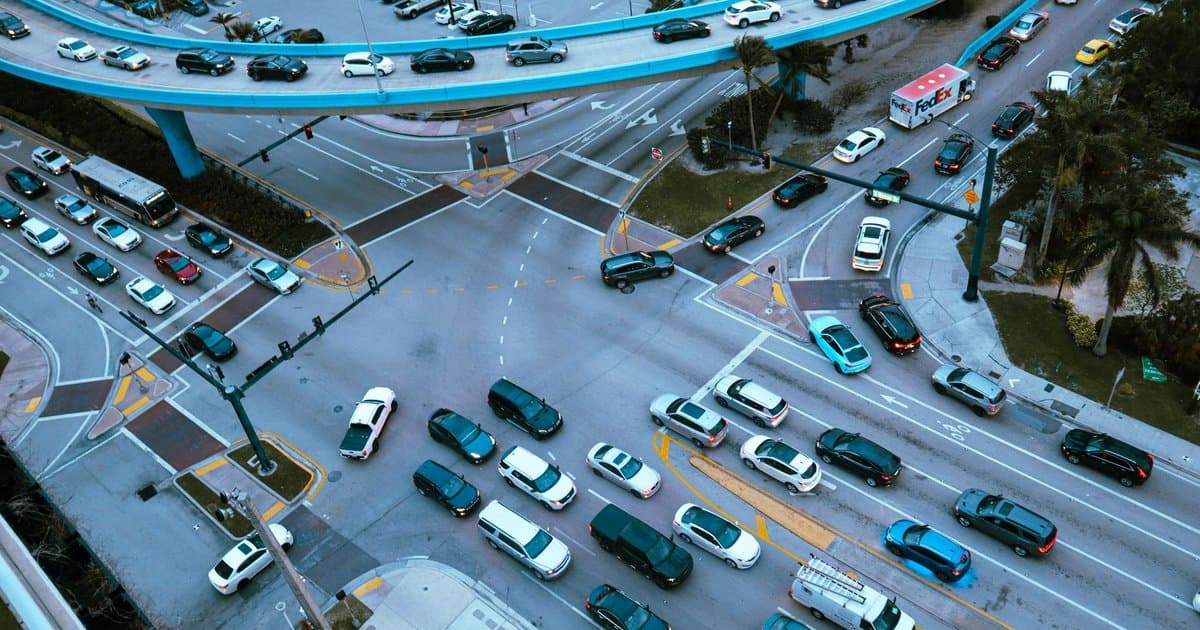
Most people picture a traffic light running on a simple timer. Red for a while, then green, then back again, like a kitchen clock bolted to a pole. That picture is wrong at most modern intersections. A large share of the signals in this country are what engineers call actuated. That means the light is watching the road and reacting to the cars that actually show up. The timer version still exists, but it is mostly saved for busy downtown grids where traffic almost never stops. Everywhere else, the light is making choices based on what it senses second by second.
Look closely at the road as you roll up to a light and you may notice faint rectangles or circles cut into the surface. Those are inductive loops, coils of wire buried a couple of inches under the asphalt. A small current runs through each loop and creates a magnetic field. When a big metal object like your car settles on top, it changes the electrical property of that loop, and the controller reads the shift as a vehicle. Here is the part that surprises people. The loop does not sense weight at all. It senses the mass of metal, which is exactly why a bicycle or a small motorcycle can sit on the line and never trigger a thing.
Loops are not the only eyes at the corner. Newer intersections often use cameras mounted on the signal arm that watch painted zones on the pavement and flag any movement. Some use radar units that bounce waves off approaching cars and measure their speed and distance. Others rely on infrared sensors that read heat. Each method has trade offs. Loops are cheap and accurate, but they get torn up every time the road is repaved, while cameras can struggle in heavy rain, glare, or snow. Many cities now run a mix, so the intersection has more than one way to know that you are there.
This explains one of the most common driver complaints of all. You pull up to a dead quiet intersection at night, no cross traffic anywhere, and the light simply refuses to turn. Usually one of two things is happening. Either the detector never picked you up, or that signal runs on a fixed night schedule that ignores demand. If you think you missed the sensor, ease forward until your tires sit right over those cut lines in the pavement, because that is where the loop is most sensitive. Motorcycle riders learn to stop directly on the wire for the very same reason. When nothing works after a full cycle, most states let you treat it as a broken signal and proceed with care once the way is clear.
Signals also talk to each other. On a long avenue, engineers coordinate a whole string of lights so a pack of cars moving at the posted speed catches one green after another. This is called a green wave, and the timing gap between each light is known as the offset. That offset is calculated from the distance between intersections and the speed the road was built for. There is a quiet lesson buried in this. Drivers who race ahead of the pack often arrive at the next light too early and get stopped, while the steady driver rolls right through. Speeding down a coordinated corridor tends to earn you more red lights, not fewer.
The yellow light is not a guess either. Its length is set by a formula that starts with the approach speed of the road. Engineers add driver reaction time, then the time a car needs to slow down safely, and the faster the road, the longer the yellow runs. A residential street might hold yellow for around three seconds, while a highway offramp can run five or six. There is even a name for the tricky stretch where you are too close to stop but too far to clear the line before red. Engineers call it the dilemma zone, and good timing is meant to shrink it. When a yellow feels too short, the road speed and the timing may simply be out of sync.
Behind many networks sits a traffic management center, a room full of screens where staff watch live camera feeds and adjust timing on the fly. Some cities run adaptive systems that retime themselves minute by minute based on how many cars are waiting. If a crash happens or a game lets out and one direction floods, the system can hand that approach more green time without a human touching a thing. These same networks handle emergency preemption. A fire truck or an ambulance can send a strobe or radio signal that flips the light green in its path and holds the cross street red. That is why you sometimes see a light change hard right before the sirens reach the corner.
So the next time you are stuck at a red with an empty road ahead, remember what is really going on under the asphalt. That intersection is a small computer running a set of rules, reading sensors, weighing demand, and deciding who moves next. It is not being lazy, and it is not being cruel. It either did not see you, or it is following a schedule written by someone who never imagined this exact quiet moment. Knowing how it works will not make the light change any faster. It will, though, turn a blank wait into a window on a system most of us pass through every single day without a second thought.