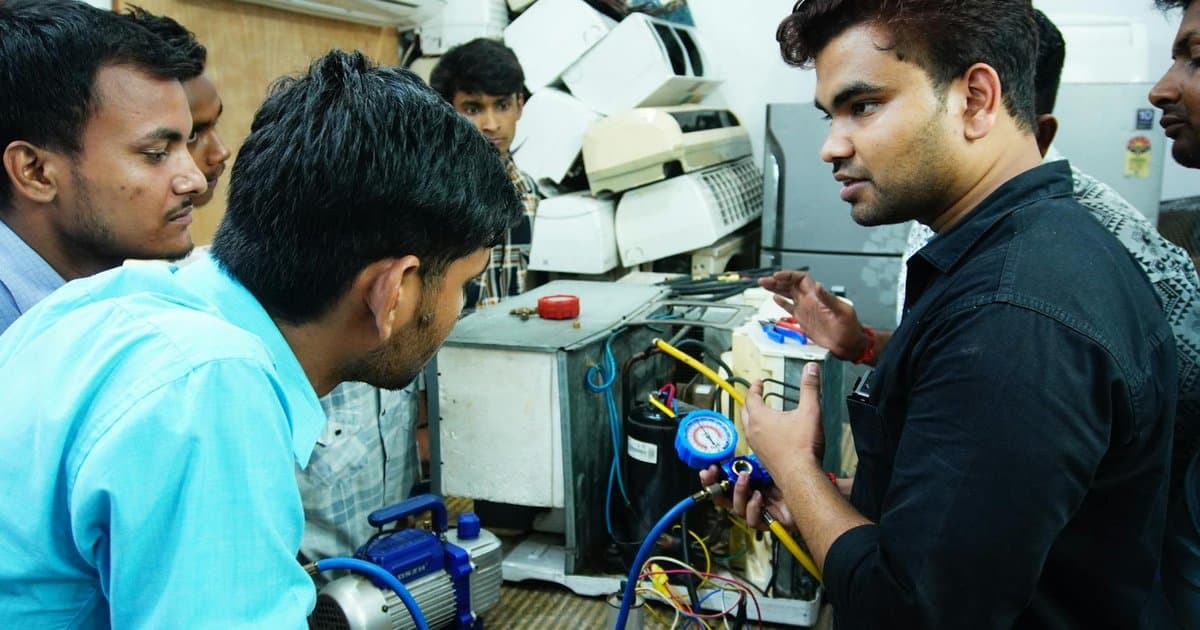
The line every parent in the south has heard since the late 1970s is go to college. That advice was correct for most of the past 50 years. It is no longer obviously correct in 2026. The price of a four year degree has tripled in real terms since 2000. The starting wage for a generic bachelor's degree graduate has barely moved. Meanwhile electricians, plumbers, HVAC technicians, welders, and skilled trade workers are earning median wages that beat most bachelor degree starting salaries, often with zero student debt and a path to business ownership the office track rarely offers.
The actual 2026 numbers from the Bureau of Labor Statistics put the comparison in plain view. Median electrician earns roughly $63,000, with experienced journeymen and master electricians earning $95,000 to $120,000. Median plumber earns $61,000 with the same upside curve. HVAC technician median is $54,000 and rising fast as the country adds residential and commercial cooling capacity. Elevator mechanic median sits at $103,000. Compare to a 2025 NACE survey of bachelor degree starting salaries at $59,000, against an average student debt load of $38,000. A 19 year old who finishes a 2 year HVAC program at Nashville State debt free and starts at $48,000 is roughly four years ahead financially of a 19 year old who borrows $60,000 to study communications.
Demand for the trades exceeds supply by a wide and widening margin. The country is short roughly 400,000 to 500,000 skilled trade workers per Associated Builders and Contractors forecasts. Boomer trade workers are retiring faster than apprenticeship programs are replacing them, and the gap is structural rather than cyclical. Construction, residential service, manufacturing, and the massive data center buildout for AI infrastructure all need skilled trade labor right now and for the next 10 to 15 years. That is stable, regional, wage growing employment, not a fad. It is also one of the last sectors where you cannot be replaced by software or offshored to another country.
The wealth building angle is what most people miss. Trade work creates business ownership pathways that office work simply does not. A licensed electrician with five years of experience can start a one truck residential service business in Nashville with $15,000 to $25,000 in tools, a used van, and a basic insurance setup. By year three, many of those businesses are doing $300,000 to $600,000 in revenue with 25 to 35 percent owner take home after expenses. The path from electrician to owner of a four truck shop billing $1.5 million is well traveled in this city. The path from communications major to owner of anything is much rarer and slower.
This is not an argument against college categorically. Engineering, medicine, law, nursing, accounting, and computer science still pay off and remain strong financial investments for most who can complete them. A degree from one of those programs at any reputable state school is still a good bet. The argument is against the default. The default for too many families has been a generic bachelor's degree in a low wage field, financed with debt, and that default is one of the worst financial decisions of the last decade for hundreds of thousands of young people who would have been better off with a different path. Pick the major and the price tag with the same care you would pick a house.
For a 17 year old in Nashville with no clear college destination, the math now looks better starting with a trade certificate at Nashville State, TCAT, or a paid union apprenticeship through the IBEW or the plumbers and pipefitters local. Earn $40,000 to $55,000 by age 20 with no debt and a real skill. Take community college business classes at night while working if the business path matters to you. By age 25, own a small service business or be on a clear track to. By age 30, the same person may be earning more than 80 percent of their college degreed peers and own equity in something the bank can lend against. The model rewards work and discipline, not credentials.
The cultural pressure to push every smart kid into a four year program is starting to look like advice from a previous economy. The new economy rewards skills, ownership, and debt avoidance. Trade work checks all three at once. Talk to your kids about it the same way your parents talked to you about college, without apology or hierarchy. Take a tour of TCAT or Nashville State together. Look at the wage data with them. The honest answer for many families in 2026 is that college is not the only path forward, and is no longer the best one.