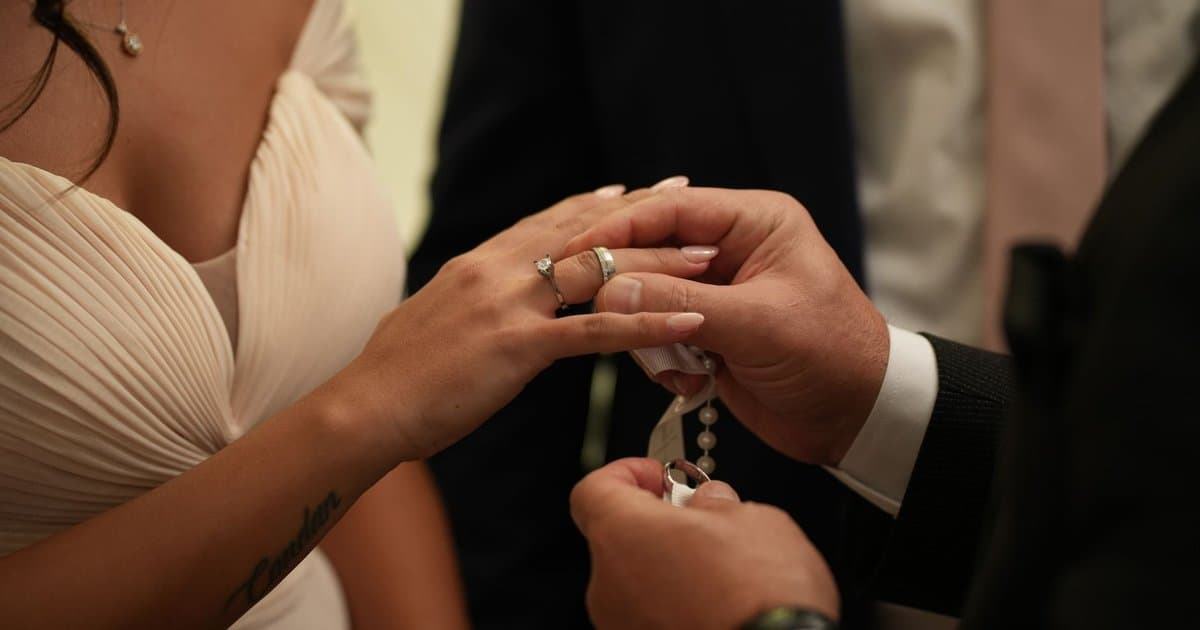
Look at your left hand and picture a wedding ring on the fourth finger. Almost everyone in the West wears it there without asking why. The common answer is a romantic one that has been passed down for ages. People say a special vein runs from that finger straight to the heart. It is a lovely idea, and it is also completely made up. There is no such vein, and there never was. The real reason the ring lands on that finger is a mix of old myth, faith, and habit.
The story goes back thousands of years to the ancient world. Romans and Egyptians are often credited with the belief in a vein of love. They thought a single vessel led from the fourth finger of the left hand to the heart. Wearing a ring there was said to seal a bond between two hearts. Latin writers even gave the vein a name that means the vein of love. The picture was so sweet that it stuck around long after anyone could check it. For centuries no one had the tools to look inside the hand and test it.
When doctors finally did look, the pretty story fell apart. Every finger has its own set of veins that drain back toward the heart. Not one of them has a private line that the others lack. The blood in your ring finger takes the same kind of path as the blood in your thumb. So there is nothing special about that finger from the body's point of view. The vein of love was a myth, plain and simple. Yet by the time science caught up, the custom was far too settled to move.
Faith and ceremony did a lot to lock the tradition in place. An old English prayer book from the fifteen hundreds spelled out the fourth finger of the left hand. As that service spread, so did the placement it named. Couples repeated the same steps at the altar for generation after generation. Each wedding taught the next one where the ring was supposed to go. What began as a myth became a rule of ritual that few thought to question. Tradition, once set in a wedding, is very hard to shake loose.
Here is the part that surprises people the most. The left hand is not the world's only choice, or even the majority one. In many countries the wedding ring goes on the right hand instead. That is common across much of Eastern and Northern Europe and in parts of the world shaped by certain church traditions. Some cultures favor the right hand because they see it as the hand of honor. Others simply inherited a different custom and kept it. So the finger you think of as obvious is really just a local habit.
There are a few practical reasons the fourth finger works well anyway. It is one of the least used fingers, so a ring there is less likely to get in the way. It sits protected between the middle finger and the pinky. The band itself carries its own old meaning, since a circle has no start and no end. People have long read that endless loop as a sign of a love with no end. So even without the fake vein, the choice carries plenty of quiet meaning. Sometimes a tradition earns new reasons long after its first one is gone.
These days people bend the custom to fit their own lives. Some switch the ring to the right hand after a spouse passes, as a quiet sign of the change. Others move it for work, since certain jobs make a ring on the main hand risky. Plenty of couples skip rings entirely or pick a finger that simply feels right. None of that breaks any real rule, because there was never a rule of nature to begin with. The finger is a choice shaped by story and culture, and choices can change. What matters is what the ring means to the two people involved. The tradition is a starting point, not a cage.
None of this means you should stop loving the old story. A vein that runs from your finger to your heart is a beautiful thing to picture. Knowing it is a myth does not drain the meaning out of the ring. If anything, the truth is more human and more interesting. People held onto a sweet idea, backed it with faith, and passed it down for thousands of years. The custom survived not because it was true, but because it meant something. That may be the most fitting reason of all to keep wearing it. In the end, the ring is a promise you can see. The story behind it only adds to that. A myth held on this long has earned its place.