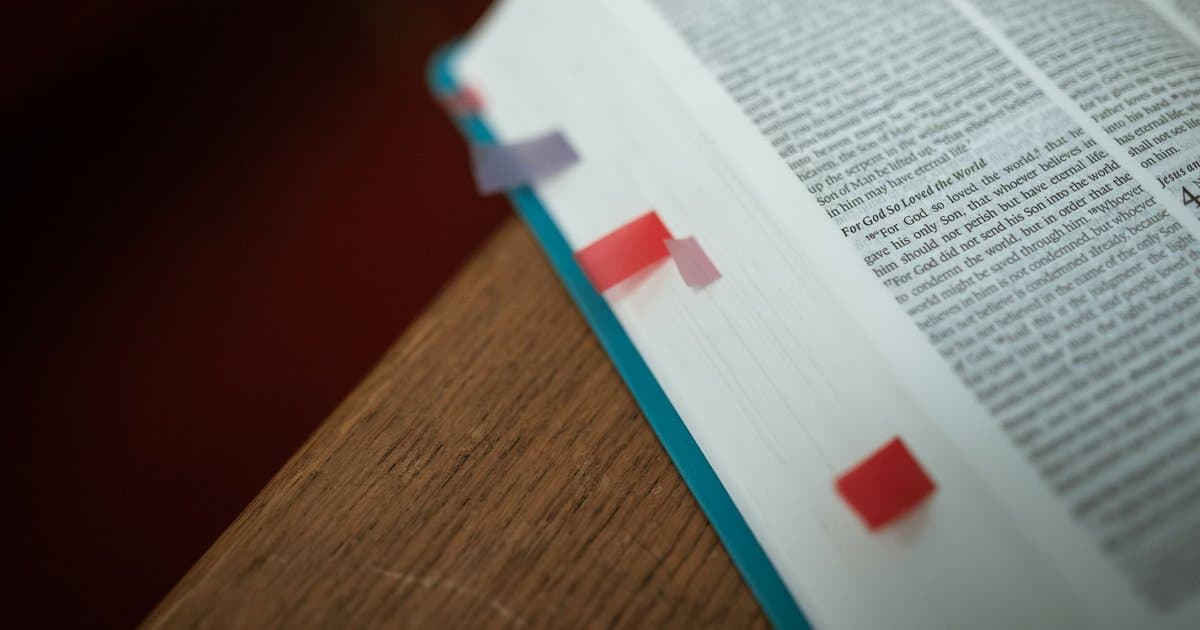
Open a King James Bible to Psalm 23 and look closely at the first line. The LORD is my shepherd, with the word is set in italics. Most readers see a slanted word and hear it stressed, the way italics work in every other book they have ever read. That reading is backwards. In these translations italics do not mean lean on this word. They mean this word was not in the original text, and the translators added it so the English sentence would work. It is a footnote built into the typeface. The convention is easy to miss and easy to misread, and most readers manage both.
The reason is grammar. Biblical Hebrew often forms a sentence with no verb at all, simply placing two things side by side and letting the reader supply the connection. The Hebrew behind Psalm 23:1 is roughly the LORD my shepherd. English cannot hold a sentence together that way, so a translator supplies is. Greek presents a related problem from the other direction, since a Greek verb ending can carry the subject inside it and a pronoun that English requires may be absent on the page. Every translation of every ancient text does this constantly. A translator who refuses to add anything produces English that nobody can read. What sets these Bibles apart is that they chose to show their work.
The practice is older than the King James Version. The 1560 Geneva Bible marked supplied words by switching type, and the 1611 King James used a smaller roman type inside its black letter text for the same purpose. When printing conventions shifted and roman type became standard for the body, italics took over the marking job, which is how later editions arrived at the look people know now. Translators refined which words were marked across successive printings, so different editions do not always agree. Comparing two printings of the same translation shows the marks moving around. The New American Standard Bible and New King James Version continue the convention today.
Once you know what the marks mean, certain verses read differently. In the King James at 1 John 2:23, the second half of the verse appears in italics, because that clause was missing from the Greek manuscripts the translators leaned on most while appearing in others they consulted. In Job, several supplied words fill gaps in poetry that is genuinely difficult in Hebrew. In the Gospels, supplied pronouns and forms of the verb to be appear so often that a reader who notices them starts to feel the shape of the underlying language. Reading with that in mind slows you down in a useful way. None of this undermines the text. It shows the seams, which is more honesty than most translations offer.
There is a real argument against the practice, and most modern committees have accepted it. The New International Version, English Standard Version, and Christian Standard Bible do not use italics this way. Their reasoning is that translation between languages is never word for word, so marking a few added words implies the rest of the sentence maps cleanly onto the original when it never does. Word order changes, idioms get reworked, and a single Hebrew word may take four English ones. Marking only the most obvious additions can create a false sense of precision about everything left unmarked. Both approaches are defensible, and they simply disagree about which misunderstanding is worse. Neither side is hiding the decision, and both explain it in their prefaces. A reader can set two translations side by side and see exactly where they part ways.
The practical risk is the one this started with. A reader who takes italics as emphasis will stress exactly the words the translators were least confident about. Read aloud in a service, that turns a note about translation into a claim about meaning, and the claim usually points somewhere the text never went. Teachers who work from the King James or New American Standard often say this early for that reason. It is a small correction that saves people from building a point on a word no author wrote. It takes one sentence to explain and it tends to stick.
There is something worth sitting with in the convention itself. A committee of translators could have smoothed the English and said nothing, and no ordinary reader would have known. Instead they marked the places where they had to step in, and left the marks on the page for four centuries of readers to question. That is a posture toward the text, not just a printing choice. Few books admit that much about how they were made. Whether or not your Bible uses italics, the habit behind them is a good one to borrow. Notice where the text is speaking and where someone is helping it along, and keep the difference clear in your own reading.