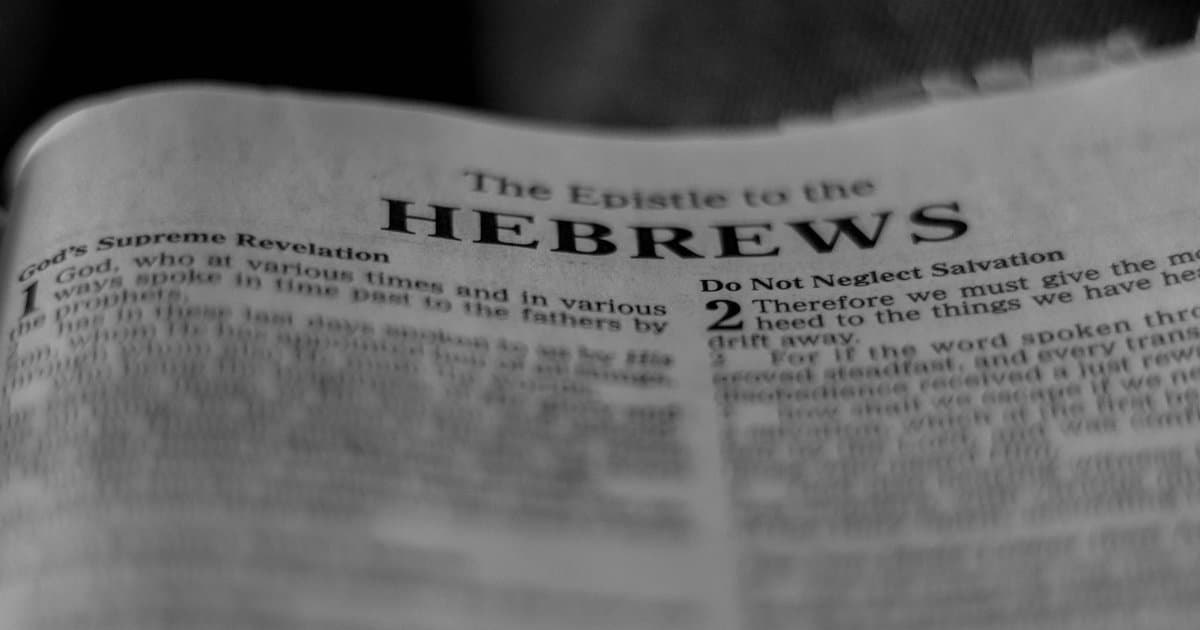
Open most Bibles to Hebrews and the heading above the text credits Paul. Read the letter itself and you will not find his name anywhere in it. There is no greeting, no signature, and no claim of apostolic authority, which sets it apart from every letter Paul wrote. The church has debated the authorship of this book since the second century and never settled it. That is not a modern discovery or a critical scholar's attack. It is an open question the earliest Christian writers acknowledged in plain terms. The honest answer is that nobody knows, and the reasons why are worth walking through.
Start with what the letter does. Paul opens his letters by naming himself, naming his audience, and offering a greeting, and he closes by naming people. Hebrews opens with a sentence about God speaking through the prophets and moves straight into an argument. It has no address at the top. It reads like a sermon that was written down and mailed, and the author himself calls it a word of exhortation near the end. The closing does mention Timothy and send greetings from Italy, which is the one personal touch in the whole book. Those few lines are what pulled early readers toward Paul in the first place.
The heading in older English Bibles came later than the text. The King James edition carries the title The Epistle of Paul the Apostle to the Hebrews, but that line is a scribal addition, not part of the original writing. Early Greek manuscripts label the book simply To the Hebrews. Titles like these were added as collections were copied and organized, and they reflect the assumptions of the copyists rather than any direct knowledge. Anyone reading a modern translation will see the shorter heading restored. The change is not a downgrade of the book. It is a return to what the manuscripts actually say.
The early church argued about it openly. Origen, writing in the third century, said the thoughts sounded like Paul but the Greek was far more polished than Paul's usual style. He then wrote a line that has followed the question ever since, saying that who really wrote the letter, only God knows. Tertullian credited Barnabas. Clement of Alexandria suggested Paul wrote in Hebrew and Luke translated it into Greek. Churches in the east accepted the letter early, while churches in the west resisted for generations and only came around by the late fourth century. The disagreement was public and it was never quietly resolved.
The internal evidence cuts against Paul more sharply than most people realize. The Greek in Hebrews is the most refined in the New Testament, built with careful rhetoric and long balanced sentences. The author quotes the Greek Old Testament almost exclusively, while Paul often works from the Hebrew. The sharpest detail sits in the second chapter, where the writer says the message was confirmed to us by those who heard the Lord. That places the author in a second generation of believers. Paul argued the opposite about himself, insisting he received his gospel directly and not from any man. Two claims that direct do not fit in one mouth.
So the field opens up. Barnabas had the Levitical background the letter's temple argument suggests. Apollos, described in Acts as eloquent and mighty in the scriptures, was Martin Luther's candidate and remains a popular one. Luke and Clement of Rome have both been proposed on stylistic grounds. In 1900 the scholar Adolf von Harnack argued for Priscilla, pointing out that a woman teaching a mixed congregation might explain why the name dropped out of the record. Every one of these names is a guess built on inference. None of them can be proved from the text or from any manuscript.
Here is the part that often gets lost. The church canonized Hebrews without resolving who wrote it, which tells you what the standard actually was. The letter earned its place on the strength of its content and its use in worship across many congregations, not on the strength of a byline. Its argument about Christ as the final high priest shaped Christian theology permanently. Congregations were reading it, teaching it, and being formed by it long before the western church signed off on the Pauline label. That order of events is worth sitting with. Use came first, and attribution followed.
For a reader today the takeaway is practical. Knowing that a book is anonymous does not weaken it, and pretending to certainty you do not have is the weaker position. Hebrews rewards slow reading because it is built as an argument, moving from the prophets to angels to Moses to the priesthood and finally to faith. Read it as a sermon and the structure snaps into focus. The writer clearly knew the Hebrew scriptures cold and wrote to people who were tempted to walk away. Whoever held the pen cared more about the message than the credit. That may be the most fitting thing about the whole book.