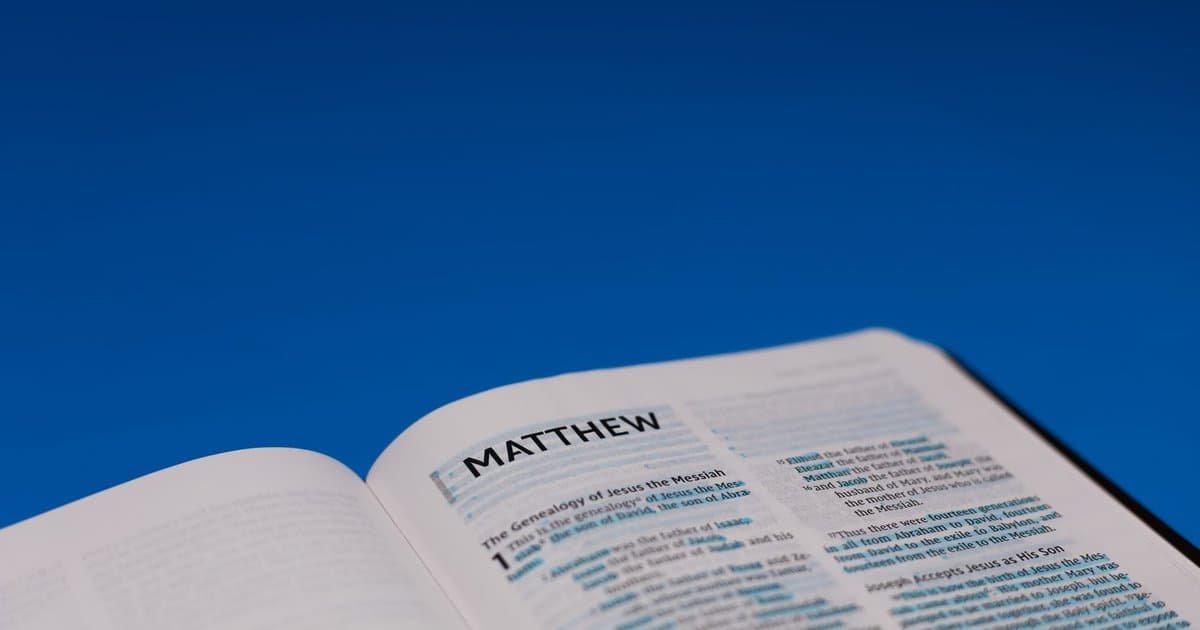
Open any Bible today and the layout feels permanent. Every book is split into chapters, every chapter into numbered verses, and you can find a single line in seconds by calling out three numbers. That grid feels as old as the text itself. It is not. For most of its history the Bible carried no chapter numbers and no verse numbers at all. The system you rely on to find a favorite passage is far younger than the words around it, and it took more than a thousand years to arrive.
The original writings had none of this. The words of the Hebrew Scriptures and the Greek New Testament were set down as continuous text. Early copies ran the words together in long blocks, sometimes without spaces between words and with little punctuation. Readers found their place by knowing the material, not by hunting for a number. A teacher could not tell a student to turn to a chapter, because chapters did not exist yet. The idea of a fixed address for every sentence had simply not been thought up. People memorized long stretches of text and used familiar phrases as landmarks. A reader might recall a story by its opening words rather than by any number. That way of reading kept the words close and personal in a way numbers never could.
The chapter divisions we use trace back to one man in the early thirteenth century. Stephen Langton, who became Archbishop of Canterbury, worked out a system of chapters around the year 1225. He applied it to the Latin Vulgate, the standard Bible of the medieval church. His scheme caught on because it made a huge book easier to teach and to debate. Scholars could point to the same section and know they were looking at the same place. Within a few generations his chapters became the shared map of the entire Bible. Teachers, students, and preachers all began pointing to the same divisions. A shared map meant that two people miles apart could study the exact same passage. That common ground changed how the church taught and debated for good.
Verses came much later and from a different man. A French printer named Robert Estienne, also known as Stephanus, added verse numbers in the middle of the sixteenth century. He put them into his Greek New Testament in 1551 and into his French Bible a couple of years after that. One old story says he marked many of the divisions while traveling on horseback between two cities. Whether or not that ride is exact, the timing is not in doubt. The verse system arrived more than three centuries after the chapters did.
This history carries a quiet lesson for how people read. The numbers are a helpful tool, but they are not part of the inspired words. A chapter break is a human decision about where one section ends and the next begins. Some of those breaks land in odd spots, cutting a single thought in half or joining two ideas that belong apart. A sentence can feel final only because a number happens to stop it there. Reading straight through, the way the first audiences did, often changes what a passage seems to say.
The scale of the system is easy to miss. Protestant Bibles hold 66 books, and those books contain more than 1,100 chapters between them. The verse count runs past 31,000 lines in all. The shortest chapter and the longest chapter sit only two chapters apart in the book of Psalms. That kind of range shows how loose the human framework really is. The numbers organize the text, but they do not measure its weight.
Knowing the numbers came late can free a reader in a real way. When you stop treating each verse as a self-contained unit, you start to see arguments that run across many lines. A single verse pulled out on its own can be bent to mean almost anything. Read inside its full paragraph, the same verse often means something narrower and much clearer. The chapter and verse grid is a filing system, not the message. Good reading uses the grid to find a passage and then sets it aside to understand one.
So the next time you flip to a familiar reference, remember what you are using. Those tidy numbers are a medieval and Renaissance invention laid over an ancient text. They helped turn a sprawling library into something a person could search, teach, and quote with ease. That was a real gift, and the church has held onto it for centuries. Still, the words came first, and they stood on their own for a very long time before anyone counted them. The map is useful, but the ground was there long before the map.