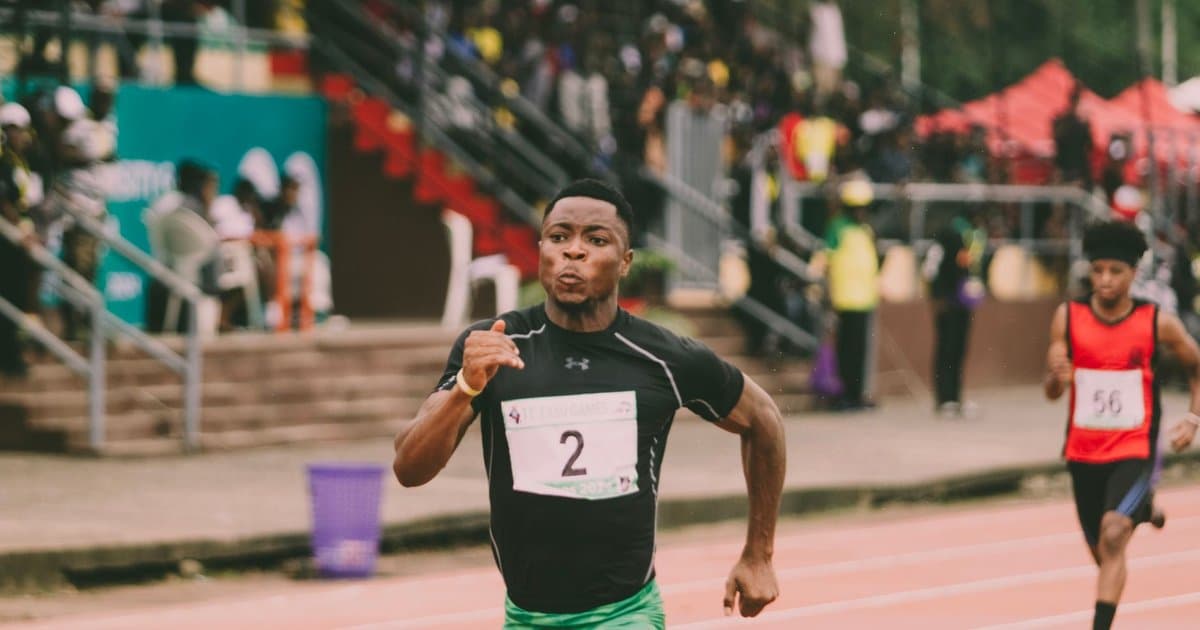
Watch the end of any elite 100 meter race and you will see something that looks like a mistake. The leaders appear to slow down in the final ten meters, sometimes visibly, even as they fight for the win. People assume this is fatigue or nerves, or that the runner let up too early. The real answer is more interesting and tells you a lot about what a sprint actually is. No human can hold top speed for the full distance, because the body simply runs out of the ability to keep firing at maximum force. The athletes are not slowing on purpose. They are obeying the limits of their own physiology.
A sprint has clear phases, and speed does not climb in a straight line across the race. Out of the blocks comes the acceleration phase, where the runner is still building velocity with every stride. Most top sprinters reach their absolute peak speed somewhere between fifty and seventy meters, not at the finish. After that point comes a phase the sport calls speed maintenance, which is a polite name for the fact that everyone is decelerating. The winner is usually the one who slows down the least, not the one who is still speeding up. Understanding this changes how you watch the race, because the drama at the end is really a contest of who fades slowest.
The reason the body cannot hold peak speed is rooted in how muscles produce power. Maximum sprinting relies on fast twitch fibers and a phosphate energy system that delivers huge output for only a few seconds. That system depletes quickly, and once it runs low the muscles cannot contract with the same force or frequency. Stride length and stride rate both begin to slip, even when the athlete is straining as hard as possible. This is why training for the 100 is not about teaching someone to run faster the whole way. It is about raising peak speed and pushing back the moment the inevitable slowdown begins.
This same principle reaches far beyond the track. Anyone who plays a sport with repeated bursts, from soccer to basketball to tennis, is living inside the same energy limits. A defender chasing a breakaway, a guard recovering on a fast break, all of them are spending the same short fuel supply and paying the same price afterward. The athletes who seem to have a higher gear late in a game are usually the ones who manage their bursts well and recover between them, not the ones with an unlimited tank. Conditioning helps you refill that supply faster and tolerate the burn longer. It does not remove the ceiling that every human body shares.
So the next time a sprinter looks like they are coasting at the line, remember what you are actually seeing. They reached a speed most people cannot imagine, held it as long as biology allowed, and then refused to fall apart while everyone around them did the same. The finish of a great race is not a failure to keep accelerating. It is a controlled fight against a slowdown that began before the runner ever felt it. That is the hidden shape of every sprint, on the track and in the run of play. Once you know it is there, you cannot unsee it. And it makes the margins at the tape, often a few hundredths of a second, far more impressive than they look.