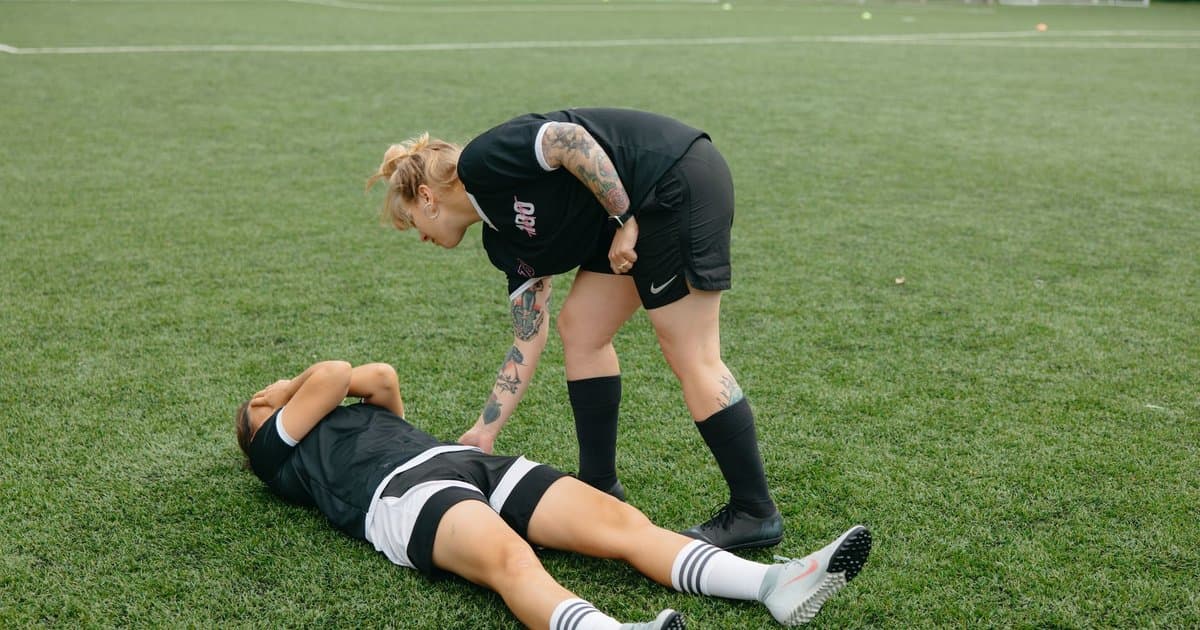
Every few seasons a star player goes down on artificial turf without anyone touching him, and the argument starts over again. The player association says the surface is the problem. The league points to studies showing modern turf performs closer to grass than older generations did. Fans split along whatever side their team's stadium happens to fall on. Underneath the noise there is a fairly consistent finding across multiple analyses of professional injury data, which is that non-contact lower body injuries occur at a meaningfully higher rate on synthetic surfaces. The gap tends to land somewhere in the range of a quarter to a third higher, depending on the years studied and the injury types counted. That is not a rounding error across a full season of games.
The mechanism has less to do with hardness than most people assume. What separates the two surfaces is how a cleat releases when a player plants and rotates. Natural grass gives way. The root system tears, a divot kicks up, and the foot slides or turns a few degrees before the body finishes the movement. That small release absorbs rotational force that would otherwise travel up through the ankle, the knee, and the hip. Synthetic fibers with rubber infill grip harder and hold longer, so the shoe stays locked while the leg keeps turning. The joint ends up absorbing energy that grass would have dissipated into the ground.
That difference shows up most clearly in specific injuries rather than across the board. Concussions and broken bones do not follow the surface pattern in any reliable way. Ankle sprains, midfoot injuries, and knee ligament damage do. The category players describe as turf toe, a hyperextension injury at the base of the big toe, is named after the surface for a reason. These are the injuries that come from a foot that stops moving before the body does. They also tend to be the injuries that cost the most weeks, which is part of why the argument carries so much weight inside locker rooms.
Turf condition matters as much as turf type, and this is the part that gets overlooked. A synthetic field is not a fixed object. The rubber infill between the fibers compacts and migrates over a season of use, and once it thins out in high traffic areas, the surface underneath gets firmer and grippier. Fields are supposed to be tested for impact absorption and rotational resistance, and well-run programs groom and redistribute infill on a schedule. Not every field gets that attention. A three year old turf field maintained properly can test better than a one year old field that nobody has touched since installation.
Grass is not automatically safer either, which complicates the clean version of this story. A poorly maintained natural field with dead patches, uneven footing, or a frozen surface in late season creates its own problems. Grass in a domed stadium struggles for light and often fails. Hybrid systems that stitch synthetic fibers into a natural root zone try to split the difference, and several large venues have moved that direction. The honest summary is that a well-maintained grass field is the safest surface available, a well-maintained synthetic field is close behind, and a neglected field of either kind is the real hazard.
The reason turf persists anyway is economics, not stubbornness. Natural grass in a stadium that hosts football, soccer, concerts, and high school championships cannot survive the schedule. Replacing sod between events runs into serious money, and in northern climates a natural field simply will not hold up in November. Synthetic surfaces let a venue book forty events instead of ten, and for most municipal and college facilities that revenue is the reason the building works financially at all. Anyone arguing the surface question purely on injury data is skipping the budget conversation that actually drives the decision.
The part that gets almost no coverage is what happens below the professional level. Elite stadiums get tested, groomed, and replaced on schedule because the players have a union and the assets on the field are worth millions. High school and municipal fields frequently do not get tested at all after the installation warranty runs out. Those are the fields where infill has thinned, where the shock pad has compressed, and where a fifteen year old is planting a foot on a surface nobody has measured in years. If the surface debate matters at the top of the sport, it matters considerably more at the level where most people actually play. That is the field worth asking questions about.