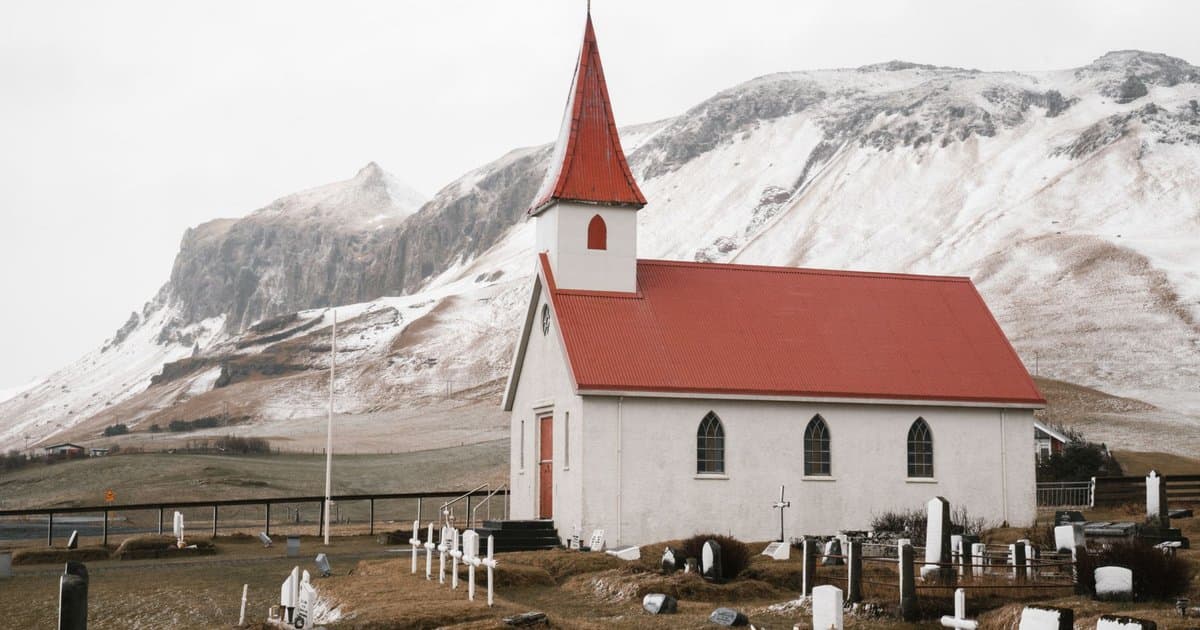
Picture a small town church and you probably picture a steeple. A white wooden building with a tall, pointed spire reaching up from the front. It is one of the most recognizable shapes in the country. Most of us drive past a dozen of them without a second thought. But the steeple is not just decoration, and it did not appear by accident. It carries a few different jobs at once, and each one has a long story behind it.
The oldest reason is the most practical. Long before phones and clocks, a town needed a way to gather people and mark the hours. The answer was a bell, and a bell needs height to carry its sound. Early churches built tall towers, sometimes standing apart from the main building, just to hang and swing them. When the bell rang, it called people to worship, announced a wedding, or warned of danger. The tower was a public address system made of stone.
The second reason is about meaning rather than function. A spire draws the eye upward, and that was fully the intent. Builders in the medieval period wanted a worshipper walking toward the church to feel pulled to look toward the sky. In a faith centered on heaven, a structure that points up is a sermon without words. The higher and sharper the spire, the stronger the pull it created. Some described the whole shape as a stone finger aimed at God.
There is a civic reason too, and it shaped whole skylines. For centuries the church was the tallest thing for miles around. A traveler could spot a village by its spire long before seeing a single house. That made the steeple a landmark, a meeting point, and a source of local pride all at once. A taller steeple than the next town over was a quiet kind of bragging. Height signaled that a community had the money, the skill, and the faith to build something that reached.
The version most Americans picture has a specific source. After a great fire destroyed much of London in 1666, an architect named Christopher Wren rebuilt dozens of churches. He topped many of them with tall, tiered white spires that balanced grace and order. Colonists carried that look across the ocean, and it became the standard for New England meetinghouses. The plain white steeple on a country road is a direct descendant of those rebuilt London churches. A style born from disaster became a symbol of home.
Building one was never simple. A spire is tall, narrow, and heavy, which makes it a constant fight against wind and gravity. Carpenters and masons had to brace it against storms that would love to tip it over. They also had to solve the problem of lightning, since the tallest point in town gets struck first. For a long time steeples burned or cracked from strikes with grim regularity. The lightning rod, once people learned to trust it, finally gave these towers a way to survive the sky they reached into.
Today the steeple is more symbol than tool. Recorded bells or none at all have replaced the heavy iron ones. Cell towers and office buildings now dwarf the old spires easily. Yet churches keep building them, and people still expect to see them there. The shape says church from a distance in a way a plain flat roof never could. It is a piece of visual shorthand that has held its meaning for roughly a thousand years.
So the next time you pass one, you are looking at several ideas stacked into a single shape. A tool for gathering a scattered town. A symbol pointing past the roofline. A landmark that once organized a whole community. A style shaped by fire and then carried across an ocean. The steeple survives because it did all of that at once, and because a clean line reaching upward still means something to the people who look up at it.