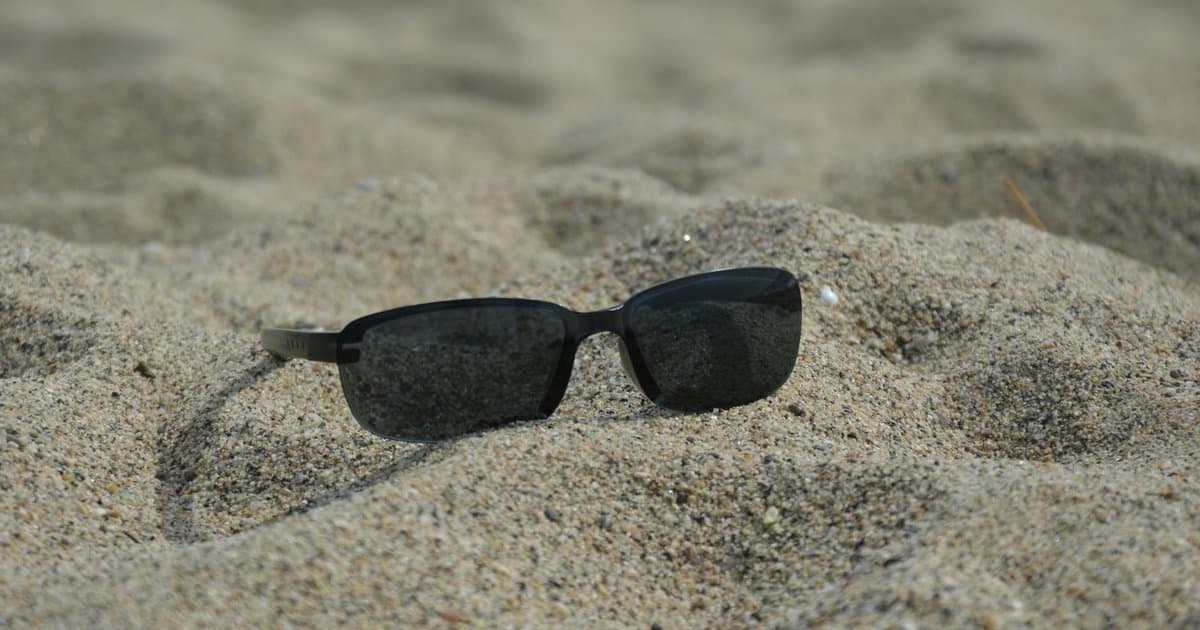
Walk into any optical shop and the price ladder runs from $25 polarized off the rack to $650 designer frames behind glass. The assumption underneath that ladder is that you get what you pay for, and for almost every consumer category that is true. Sunglasses are the exception. The lens performance metrics that protect your eyes from sun damage are commodity science, the labs that test them are the same labs no matter who is paying, and the price gap is almost entirely tied to brand licensing, retail margin, and frame material rather than to anything that affects your vision. Once you understand what the label actually has to do, the $400 pair stops looking like an upgrade and starts looking like a tax.
The metric that matters most is UV protection, and the rule is binary. Sunglasses sold in the United States have to block 99 to 100 percent of UVA and UVB to carry the standard label. A $25 pair from a sporting goods store and a $450 luxury pair both meet that threshold. The American Optometric Association tested 117 pairs across price tiers in a 2023 review and found no statistical difference in UV transmission between the cheap end and the expensive end. What you do not want is a fashion frame sold in a kiosk without a UV rating sticker, because tinted lenses without UV blocking actually dilate the pupil and let in more UV than wearing nothing. Cheap and untested is a problem. Cheap and properly rated is identical to expensive and properly rated.
The second performance metric is polarization, and this is where price scales somewhat with quality but not the way most buyers assume. A polarized lens cuts glare from horizontal surfaces like wet roads, car hoods, and water. A $40 polarized lens from Knockaround or Goodr cuts glare effectively. A $200 polarized lens from a mid-tier brand cuts the same glare with slightly better optical clarity. A $400 polarized lens from a luxury brand cuts the same glare again with marginally better edge clarity if you are looking through the corner of the lens. For driving, fishing, or daily commuting, the gap between $40 and $200 is real. The gap between $200 and $400 is mostly cosmetic and is almost entirely about the frame and the logo.
Frame material is the only place the premium price actually buys you a meaningful upgrade. Acetate frames at the $80 to $200 range hold their shape, resist heat warping, and last five to seven years. Cheap injection-molded plastic at the $15 to $25 range warps after two summers in a hot car and feels loose by the end of year one. Titanium frames at $250 and up are nearly indestructible, weigh half what acetate weighs, and survive being sat on. So the honest spending logic is reversed from how most stores display it. Spend money on the frame, save money on the lens. A $180 titanium frame with a properly rated $40 lens beats a $450 acetate frame with the same lens on every metric except status.
Scratch resistance and lens coatings are where marketing gets the loudest and the testing data gets the thinnest. Most premium lenses advertise hydrophobic coatings, anti-reflective coatings, and mirrored finishes. A 2024 Consumer Reports test of 40 lens sets across price tiers found that coating durability after one year of daily wear ranged from "barely noticeable" to "completely worn off" with almost no correlation to price. The lenses that survived best were polycarbonate base lenses from mid-priced brands like Costa, Maui Jim Pro, and Smith Optics. The worst performers included two designer pairs in the $400 to $600 range and three sub-$30 pairs. Price was not the predictor. Polycarbonate base with a single hard coat outperformed multi-layer luxury coatings on most pairs.
There is one quiet case for spending more, and it is fit. A pair of $300 frames sized correctly for your face hugs the bridge, rests on the temples without pressure, and stays put when you look down. A pair of $30 frames sized to fit "most adults" usually does not. If your face is narrow, wide, low bridged, or high bridged, the cheap pair will slide, pinch, or sit crooked, and you will eventually stop wearing them. An optician fitting is the upgrade most people skip and the one that actually changes whether the glasses get used. Many optical shops will fit a frame you bought elsewhere for a $25 adjustment fee. Take advantage of that service before paying triple for a brand you wear once.
The buying rule that follows from the data is simple. Pick the lens by the rating, pick the frame by the build, and pick the fit by an in-person try-on. A $90 setup of a polycarbonate polarized lens in a properly fitted titanium or quality acetate frame outperforms a $450 designer pair on every metric except the logo on the temple. If the logo is what you want, that is a separate purchase. Treat it as jewelry rather than as eye protection, and pay for it with that framing in mind.