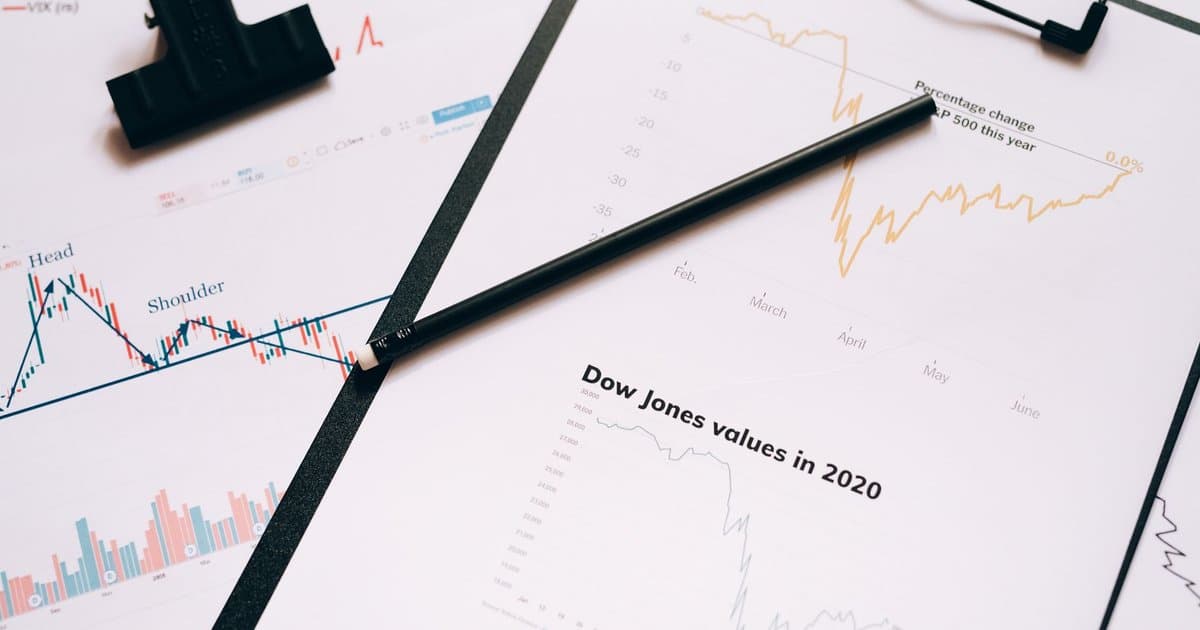
You hear it every evening on the news. The Dow rose two hundred points, the Dow fell three hundred, as if that single number tells you how the market did. Most people treat it as the market itself. Here is what almost no one realizes. The Dow Jones Industrial Average tracks just thirty companies, hand picked by a committee, out of the thousands you could actually own. And the way it weighs those thirty is strange enough that the number can move for reasons that have little to do with how the broad market truly performed. Once you see how it is built, you stop trusting it as a summary.
The core oddity is that the Dow is price weighted. That means a company's influence on the index depends on the price of a single share, not on how big the company is. A stock trading at four hundred dollars a share pushes the Dow around far more than a stock trading at fifty dollars, even if the fifty dollar company is worth several times more in total. Share price and company size are only loosely related, because a share price is partly just a function of how many shares a company chose to issue. So the Dow hands the loudest voice to whichever members happen to carry the highest sticker price, which is a strange way to measure anything at all.
Picture two companies inside the index. One is a giant worth a trillion dollars whose shares happen to trade around fifty dollars. The other is a solid but much smaller firm whose shares trade around five hundred dollars. In the Dow, the smaller company moves the number about ten times as much as the giant, purely because of the share price. If that smaller company has a rough day and the trillion dollar giant has a great one, the Dow can fall even though far more market value actually rose. The index is telling you a story about share prices, not about the real weight of the companies inside it.
There is another layer that trips people up, and it is the word points. A Dow point is not a dollar and not a percent. Because of stock splits and changes to the lineup over the years, the index is calculated using a special divisor that keeps the long history continuous. The upshot is that a move of three hundred points sounds dramatic but has to be measured against the level of the index. On an index sitting around forty thousand, three hundred points is less than one percent, a perfectly ordinary day. Headlines love a big point number because it sounds alarming, even when the actual percentage move is small and unremarkable.
Now compare that with the index professionals actually watch, the S&P 500. It holds five hundred large companies instead of thirty, so it covers far more of the market. And it is weighted by market value, not share price, so each company's influence matches how big it truly is. That is a far more honest picture of how American business is doing on a given day. Broader total market indexes go further still, holding thousands of companies at once. When an investor wants to know how the market really performed, these are the numbers that answer the question. The Dow is the famous one, but it is not the accurate one.
So why does the Dow still lead the headlines. Mostly history and habit. It launched back in the eighteen nineties, long before the broader indexes existed, and it became the number the public learned to recognize. News outlets keep quoting it because their audience knows the name, and the name carries a weight the math no longer earns. There is nothing dishonest about reporting it. It just measures much less than most listeners assume, and it measures it in a quirky way that can point in the wrong direction on any given day. Familiarity, not accuracy, is the reason it survives.
None of this means you should track the market minute by minute, and for most people watching daily moves is a waste of attention anyway. But if you are going to glance at a number, it helps to know what it is telling you. The Dow is thirty companies weighted by share price, a narrow and slightly distorted lens on the market. The S&P 500 and broader total market indexes give you a far truer read. If you own an index fund, check which one it actually follows, because that is the market you are invested in. Know what the number measures before you let it tell you how you are doing.