There is a loss happening in your body right now that you cannot feel and probably are not tracking. Starting somewhere in your thirties, adults begin to lose muscle mass, and the slide picks up speed after forty and again after sixty. The medical name for this age related muscle loss is sarcopenia. Estimates vary, but many researchers put the loss at roughly three to eight percent per decade after thirty, with the rate climbing as you get older. Because it happens so slowly, almost nobody notices it until something they used to do easily suddenly feels hard. By then a lot of ground has already been given up.
This is not just about looking softer or filling out a shirt differently. Muscle does real work in the body beyond moving you around. It is a major site where your body handles blood sugar, so losing it makes it harder to keep glucose in a healthy range. It supports your metabolism, which is part of why weight tends to creep up with age even when eating stays the same. It protects your joints and helps your bones stay dense under load. When muscle quietly disappears, all of those background jobs get harder, and the effects show up as problems that look unrelated.
The real cost lands later, and it is bigger than most people expect. Picture a person in their late seventies who never trained. The muscle loss that started decades earlier has now compounded into genuine weakness. Standing up from a low chair is a struggle, and catching themselves after a stumble may no longer be possible. A single fall can lead to a broken hip, a hospital stay, and a permanent loss of independence. Frailty is not bad luck for most people. It is the predictable end of muscle that was never defended along the way.
Here is the part that should give you hope. Muscle responds to training at essentially any age, including in people well into their eighties and nineties. Landmark studies decades ago put frail nursing home residents on simple resistance programs and watched them get measurably stronger and steadier in a matter of weeks. The body does not lose the ability to build muscle as it ages. It only loses muscle when nothing asks it to stay. The moment you start giving it a reason to hold on, it starts cooperating, and it is rarely too late to begin.
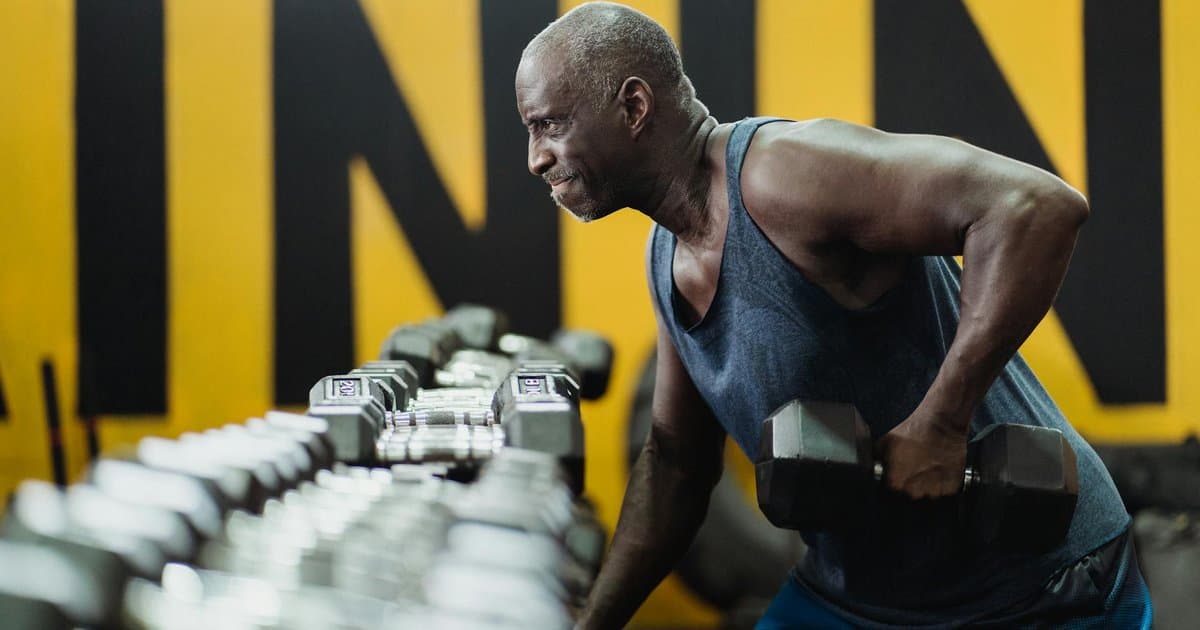
What actually works is less complicated than the fitness world makes it sound. The key is resistance training two to three times a week, where you challenge the major muscle groups against meaningful load. That can mean dumbbells, machines, resistance bands, or even your own body weight to start. The important thing is that the work gets gradually harder over time, because muscle only adapts when you ask a little more of it. Pairing that training with enough protein, spread across your meals, gives your body the raw material to rebuild. Two short, focused sessions a week beat a perfect plan you never start.
Most of the reasons people give for not starting fall apart under a closer look. Some feel they are too old, but the research on older adults points the opposite way. Some find the gym intimidating, which is fair, though a few bands and dumbbells at home remove that barrier entirely. Many assume their daily walks or cardio already cover it, but cardio and strength work do different jobs, and one cannot replace the other. Walking is excellent for your heart and should continue. It simply does not stop the muscle loss that strength training is built to reverse.
You do not need to become an athlete or live in a gym to win this. You need to make resistance training a regular, ordinary part of your week and keep it up for years, not weeks. Think of it the way you think of brushing your teeth, a small non negotiable that protects something you cannot easily get back. The version of you at seventy or eighty is being built right now, by what you do or skip today. Every session you do is a deposit toward staying strong, steady, and independent.
The cost of skipping strength training after forty is not paid all at once. It is paid slowly, in a body that gets weaker than it had to, and it comes due at the worst possible time. The fix is available to almost everyone, it is cheap, and it works at any age you choose to start. You do not need fancy equipment or a perfect program to begin, just a willingness to challenge your muscles and the patience to keep showing up. Strength built steadily over years is what carries you through the decades when it matters most. Pick up something heavy a couple of times a week and keep doing it. Your future self is the one who collects on that effort.