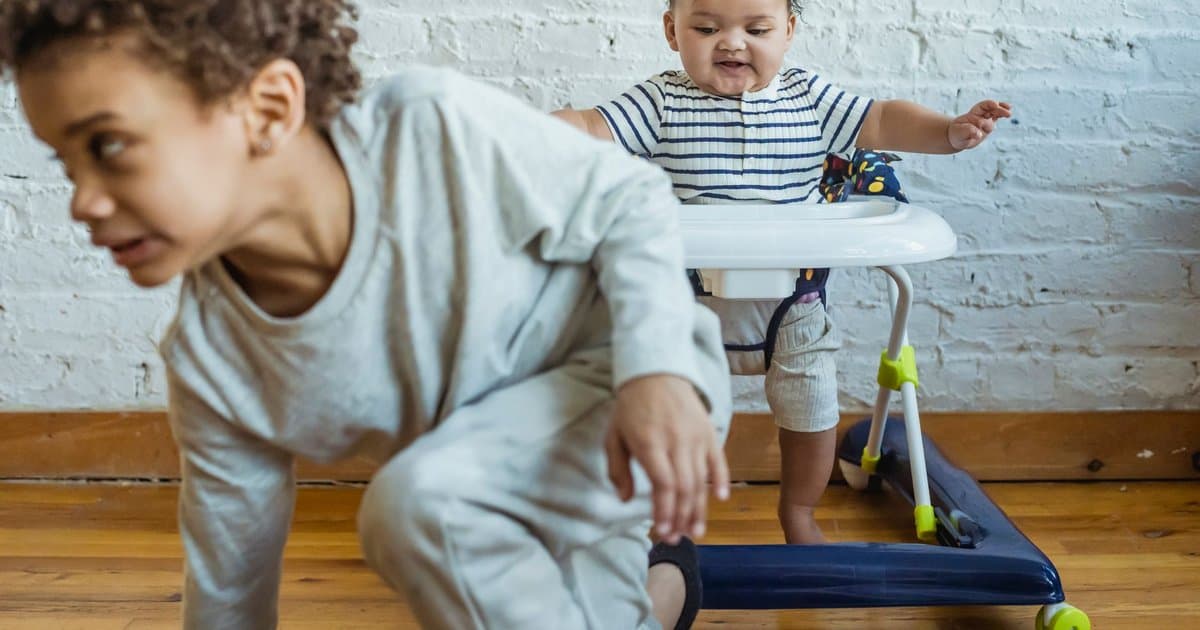
Walk into almost any store that sells baby gear and you will find them, the round plastic seats on wheels that let an infant scoot across the floor with their feet. The pitch behind them sits right there in the name. A baby walker is supposed to help your baby learn to walk. Parents have believed this for generations, and the logic feels obvious enough on the surface. Put the baby upright, let them push around the kitchen, and surely they will get the hang of walking sooner. The research says the opposite is true, and it has for years now.
Studies that followed babies who used walkers found they tended to reach their movement milestones later, not earlier. On average, walker babies sat up, crawled, and walked on their own slightly later than babies who never used one at all. One widely cited study found that more walker time was linked to more delay, milestone by milestone. The device marketed to speed things up was quietly slowing them down instead. It stands as one of the clearest gaps you will find between what a product promises and what it actually delivers. The name sells a result the thing cannot give.
The reason comes down to how babies actually learn to walk in the first place. Walking is not just a matter of moving your legs back and forth. It is a full body skill that depends on core strength, balance, and the constant feedback a baby gets from pushing up, tipping over, and trying again on the floor. A walker skips over all of that. It holds the baby upright before their body is truly ready and lets them move by pushing with their toes, which builds the wrong muscles in the wrong pattern. Many walkers also block the baby from seeing their own feet, cutting off feedback that helps them learn to control their legs.
Floor time is where the real learning happens. When a baby crawls, pulls up on furniture, and cruises along the edge of the couch, they are building the exact strength and coordination that walking demands. They learn how their weight shifts from one side to the other. They learn how to catch themselves during a fall. They learn to trust their own balance through hundreds of small, low stakes tumbles. A walker lifts a baby out of that classroom and props them up in a shortcut that teaches almost none of it. The shortcut feels productive to watch, and it mostly is not.
The delay is only half of the problem. Baby walkers are also one of the more dangerous products ever sold for infants. They hand a baby who cannot yet walk the power to move several feet in a single second, faster than most parents can react. That speed sends babies tumbling down staircases, rolling toward hot stoves, and reaching countertops and outlets they could never touch on their own. Emergency rooms have treated tens of thousands of walker injuries over the years, many of them head injuries from falls. A device meant to be helpful can turn an ordinary room into a genuine hazard.
The evidence eventually became strong enough that officials stepped in. Canada banned the sale of baby walkers back in 2004, becoming the first country to outlaw them outright. The rule there even covers used walkers sold at yard sales, and it carries real fines for breaking it. In the United States, the American Academy of Pediatrics has called for a full ban on making and selling them for years. Safety standards have made newer walkers harder to tip over and too wide to fit through most doorframes. Even so, doctors remain clear that a safer walker is still not a good idea.
The good news is that babies do not need any special gear to learn to walk. They need floor space, a little supervision, and time. Stationary activity centers, the kind that spin and bounce but do not roll anywhere, give a baby something to do without the danger or the delay. Simple play on a firm surface does more for development than any wheeled seat on the market. When a baby is ready to pull up, sturdy furniture and a parent's steady hands are the only tools truly required. The body already knows the sequence, and it does not need to be rushed through it.
None of this makes a parent who used a walker a bad parent. These products sat on store shelves for decades with a reassuring name and a confident promise, and trusting them was reasonable. But the science is settled enough now to say it plainly. A baby walker does not help your baby walk, and it carries a real risk of harm along the way. The thing that actually works is slower, quieter, and completely free. Give a baby room to move, let them fall in safe ways, and stay close by. That is how walking is learned, and it always has been.