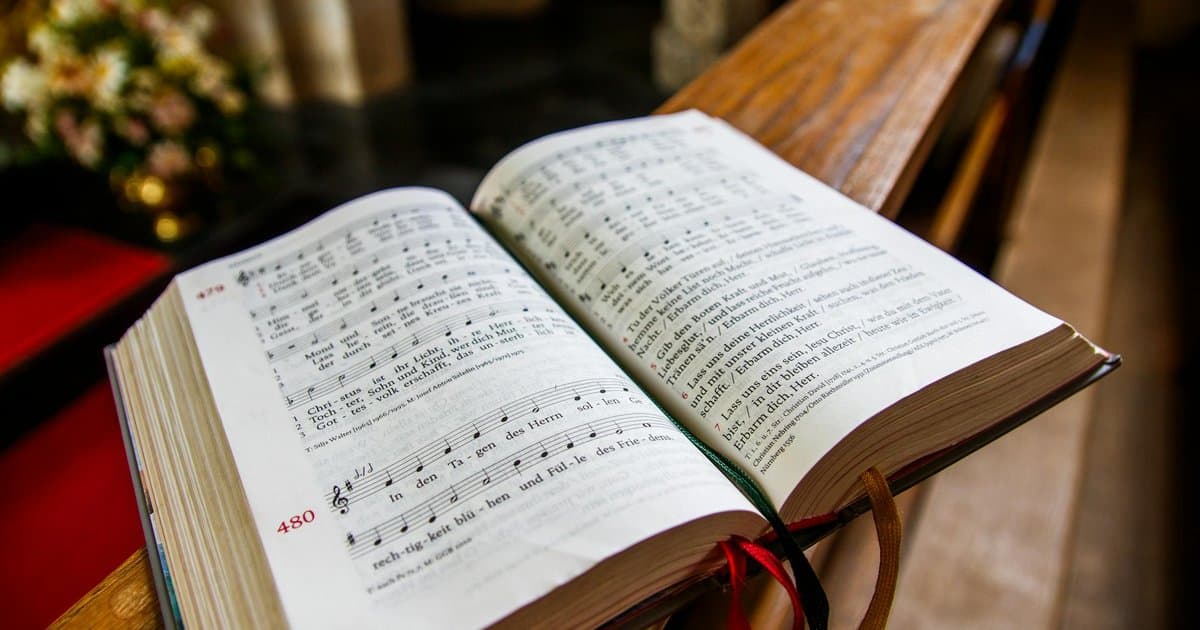
Open most Bibles to the book of Psalms and you will notice small notes printed above many of the chapters. They say things like "to the choirmaster," "with stringed instruments," or "according to The Doe of the Dawn." Those lines are easy to skip, and most readers do exactly that. They are not random labels or ancient clutter left behind on the page. They are performance directions, the kind a worship leader would hand to a band before a service starts. The Psalms were never meant to be read silently in a quiet room by yourself. They were written to be sung out loud by a gathered people, often with instruments and trained voices carrying the melody.
The numbers behind this are larger than most people expect. Of the 150 psalms, the heading "to the choirmaster" sits above 55 of them. Dozens more carry the word "selah," which scholars believe marked a musical pause or a rise in volume. The collection names specific instruments again and again, from the harp and lyre to the trumpet, the tambourine, and crashing cymbals. Psalm 150 alone lists eight different instruments in its six short verses. Several headings even point to named melodies the first singers would have recognized instantly, tunes whose titles survived in the text even though the music itself was lost.
King David, who is tied to roughly 73 of the psalms, organized a permanent body of musicians for worship. The book of Chronicles describes four thousand people set apart to praise God with instruments and 288 trained singers divided into rotating shifts. They operated much the way a professional choir operates today, with section leaders, assignments, and a working schedule. When the temple was later destroyed and then rebuilt, restoring the music was one of the first priorities the returning people pursued. They wanted the singing back before they finished much else, which tells you how central it was to their life with God. Worship without song would have seemed incomplete and strange to them.
The singing did not stop when the temple era ended. The early church carried the practice straight into its own gatherings. Paul told the believers in Colossae to teach and correct one another "with psalms and hymns and spiritual songs." He gave nearly the same instruction to the church in Ephesus, urging them to sing and make melody to the Lord in their hearts. Jesus himself sang a psalm with his disciples on the night before his death, almost certainly one of the Hallel psalms tied to Passover. The thread runs unbroken from the temple courts to the upper room to the small house churches that came after.
The range of what they sang is worth sitting with for a moment. These were not only triumphant anthems written for good days and full harvests. The psalms include raw complaints, open doubt, and cries that border on accusation against God himself. Psalm 88 ends in darkness with no resolution, and it was still set to music and sung anyway. Psalm 137 voices the bitterness of exile in language most modern worship sets would never touch. The people who sang these did not trim their worship down to the parts that felt pleasant or polite, which is part of why the collection has endured.
Knowing this changes how the book reads. A psalm like Psalm 23 stops being a poem to scan and becomes a song someone once sang through tears or in deep relief. The laments make more sense when you picture them sung in a crowd rather than whispered alone, because grief shared in song lands differently than grief read in silence. Many of us inherited a quiet, individual way of meeting God, and there is real value in that kind of stillness. But the people who first received these words did something most of us rarely attempt. They set the hardest and the highest moments of their lives to music and sang them shoulder to shoulder.
You do not need a choir or an instrument to recover some of this for yourself. Try reading a psalm out loud instead of in your head and notice how the rhythm shifts the moment your voice carries it. Pay attention to the headings you usually pass over, since they were left there on purpose by people who treated worship as something to be heard. If you sing in church on Sunday, remember you are joining a practice that runs three thousand years deep. The Psalms were a songbook before they were anything else. They still work best when you let them sound like one.