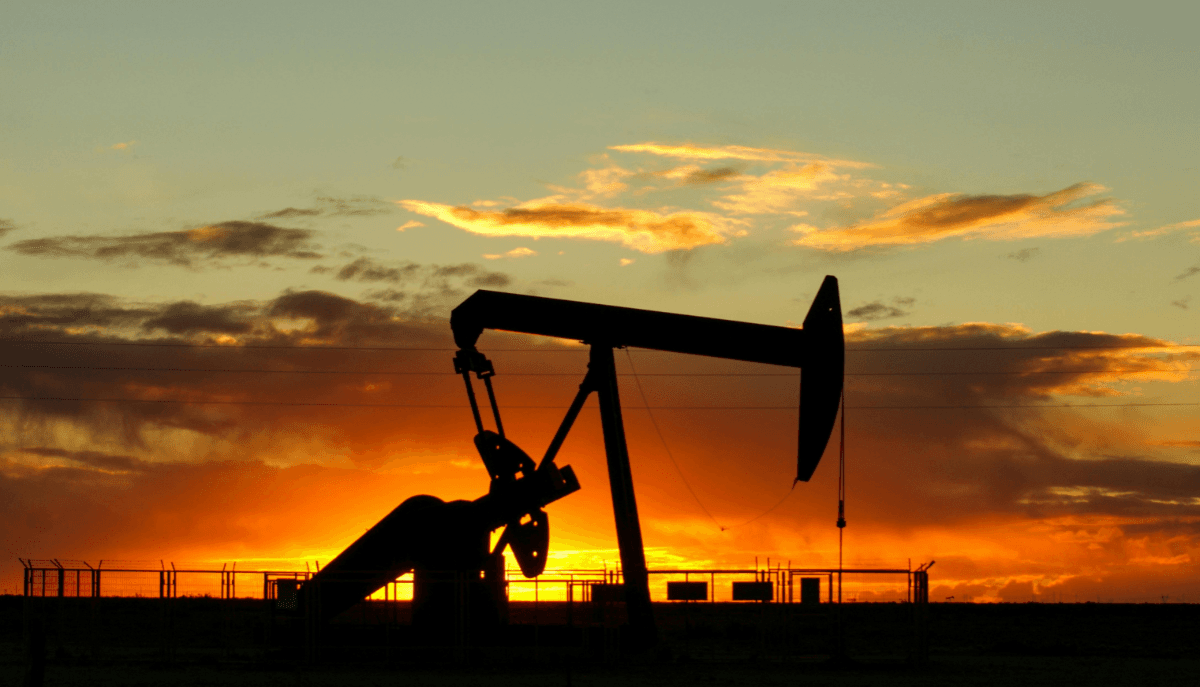
The S&P 500 is up 10.4 percent year to date as of the close on Monday, May 4, 2026. Energy is up 38.4 percent. The sector that gets the least attention in most retirement accounts is the one that has done the most this year, and the gap between energy's return and the index's return has widened in each of the last four weeks. Most diversified portfolios have somewhere between zero and three percent in energy because the standard index weighting puts the sector below four percent of the S&P 500. That allocation has been a drag on returns for any portfolio that mirrored the index this year.
The driver is Brent crude. Brent spiked to $114.44 a barrel midday Monday on the Iran-related shipping tension in the Strait of Hormuz and a Fars news agency claim of two missile strikes near US Navy positions, then settled at $108.44 at the close after the US Navy denied the Fars report at 12:48 PM Eastern. WTI closed at $102.40, down from a $107.18 intraday high. Even after the retracement, Brent is sitting at levels not seen since the second quarter of 2022. Spot oil this high resets the entire profitability picture for integrated majors and US shale producers, who priced their 2026 capex assuming WTI in the $72 to $84 range. Every dollar above the planning assumption flows through to free cash flow.
The two largest US integrated majors led the sector higher Monday. Exxon Mobil closed up 4.7 percent. Chevron closed up 3.9 percent. Both are above their 2014 highs in price and well above them in earnings power because the cost basis on production has fallen since 2020 while breakevens have improved. Exxon's free cash flow yield at the current oil strip runs above 11 percent. Chevron's runs above 9 percent. Those are dividend coverage numbers reminiscent of the late 1990s energy cycle and far outside the rest of the market.
The pure-play producers have run further. Pioneer Natural Resources, EOG, and Diamondback Energy are each up 41 to 58 percent year to date. The smaller Permian basin operators benefit most from the price move because their production is unhedged into the second half of the year, and they have less capital intensity per barrel than the integrated majors. The risk on this group is the opposite. If Brent retraces toward $90, the smaller producers give back gains faster than the majors.
Midstream is the segment most retirement investors should look at. Pipelines, storage, and processing operators benefit from the volume side of the energy cycle. Tariff income rises with throughput. Master Limited Partnerships like Enterprise Products Partners and Energy Transfer pay distributions in the seven to nine percent range and have raised them in each of the last twelve quarters. The MLP structure complicates tax filing, with the K-1 form replacing a 1099, but the after-tax yield is usually higher than C-corp dividends in the same sector.
Oil services is the third group worth reviewing. Schlumberger, Halliburton, and Baker Hughes are up 28 to 34 percent year to date. Services companies generate revenue when producers drill, and rig counts in the Permian climbed from 312 in January to 348 by April. Services equities lag oil price moves by three to six weeks because the spending decisions take time to flow through to contracts.
The case against an overweight is not weak. Oil prices are volatile and largely driven by supply shocks and OPEC discipline, neither of which is predictable. Energy was the worst-performing sector for most of the 2014 to 2020 stretch and lost 35 percent of its index weight before the post-pandemic recovery. The sector also faces structural headwinds from EV adoption, which has slowed but not reversed, and from utility-scale solar and storage buildout, which displaces gas demand on the margin.
The argument for some allocation is straightforward. Energy is the only sector that has historically protected against geopolitical shocks and supply-side inflation. The two market regimes that hurt traditional 60-40 portfolios are sustained inflation and oil shocks. Both happened in 2022 and could happen again. A four to seven percent energy allocation, half in integrated majors and half in midstream, has shown a 38 percent reduction in portfolio volatility during oil-driven inflation cycles in the last forty years according to a 2024 Morgan Stanley study.
The cleanest implementation is two ETFs. The Energy Select Sector SPDR Fund, ticker XLE, holds the major US integrated and pure-play producers in an expense ratio of 0.10 percent. The Alerian MLP ETF, ticker AMLP, holds the largest US midstream MLPs in a structure that avoids the K-1 issue at a 0.85 percent expense ratio. A 4 percent XLE plus 3 percent AMLP allocation gives the portfolio meaningful energy exposure with one trade per fund.
The Federal Open Market Committee meets Tuesday and Wednesday this week. Markets are pricing a 64 percent probability of a June rate cut. A dovish surprise weakens the dollar and supports oil. A hawkish surprise does the opposite. Position sizing matters this week because of that.
Energy has had three years like 2026 in the last forty. In each of those, the sector returned more than 35 percent for the year and pulled back 20 percent in the following year. Take the gains seriously, do not overstay, and rotate back to underweight after the cycle. That is how the sector pays in the long run.