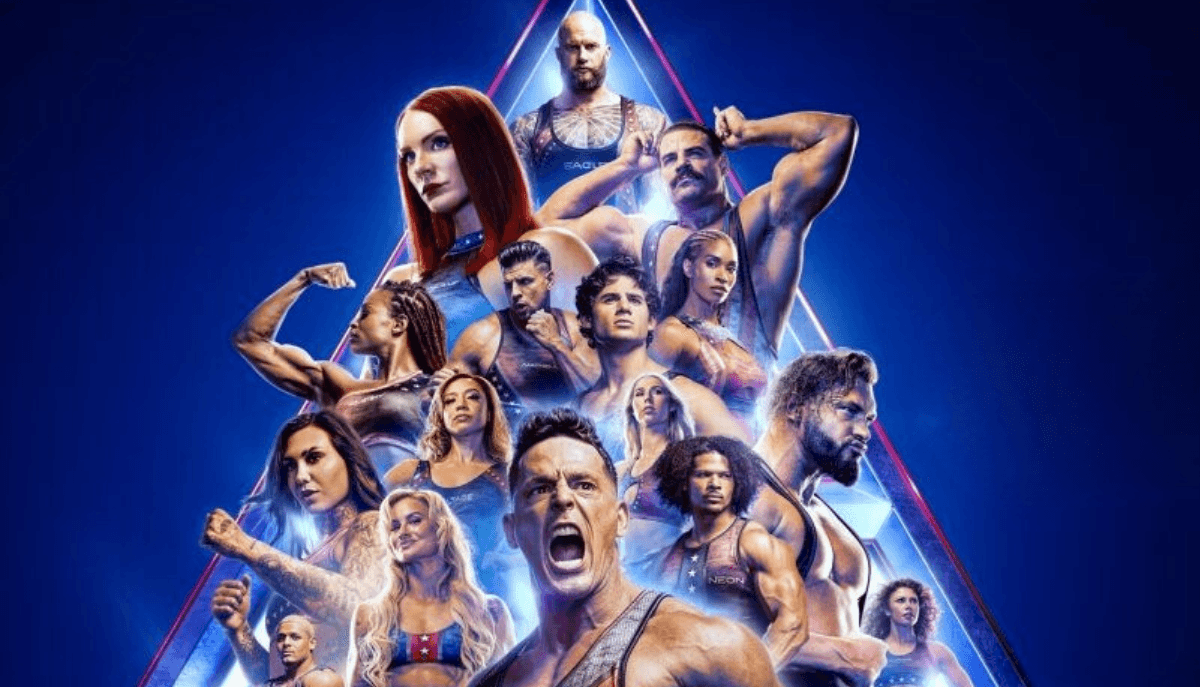
American Gladiators returned to television on April 17 with a Prime Video premiere that borrows the spirit of the 1989 original and rebuilds nearly everything else. The show is set in a purpose-built arena in Los Angeles, features eighteen professional athletes as the new Gladiators, and runs on a bracket format that eliminates contestants across a season that concludes with a $2 million prize for the last competitor standing. The production value is closer to what streaming audiences expect from prestige sports programming than what old-school fans remember from syndication. This is not a nostalgia play with cheap sets and a laugh track. It is an attempt to build a legitimate physical competition show for a modern streaming audience.
The format changes are meaningful. Original American Gladiators ran event by event in discrete segments, with contestants racking up points across a series of physical challenges. The 2026 version keeps the event structure but restructures it into a tournament bracket where early-round eliminations matter and the later rounds carry real stakes. Each of the events has been redesigned. The Joust has new arena geometry and a wider platform. Assault has been rebuilt with updated targeting technology. The Eliminator obstacle course that closed every season has been scaled up significantly and now features aquatic, elevation, and climbing elements in a sequence that takes the average competitor more than 90 seconds to complete.
The cast matters as much as the format. The new Gladiators are drawn from professional combat sports, track and field, CrossFit, American Ninja Warrior, and collegiate athletics. Several of them are already well known within fitness and combat sports communities and have built substantial followings on YouTube and Instagram. Amazon made the decision to lean on legitimate athletic resumes rather than personalities built purely for the show. The result is a cast that performs at a level the original show's Gladiators, strong as they were, could not have matched. This is closer to what Fight Night meets Olympic decathlon looks like on television. It is not a camp production.
The contestant pool is also more serious. Auditions drew more than forty thousand applications for sixty-four final spots. The show's producers filtered heavily for athletic background, conditioning level, and storyline strength. The final sixty-four include former college athletes, military veterans, police officers, firefighters, professional trainers, and a smaller number of amateur sports competitors. Every contestant had to pass a medical clearance process that included cardiac screening and a functional movement assessment. These are not people who trained for six weeks and went on television. Most of them have been serious athletes for a decade or more.
What Amazon is clearly trying to build is a flagship sports entertainment property that can live inside the Prime Video subscription over a long time horizon. The investment levels suggest a multi-year commitment. Set construction alone reportedly cost more than $60 million. The company is also producing a companion docuseries following select contestants through their training, qualification, and tournament runs. That approach mirrors what Netflix did with Formula 1 Drive to Survive. The bet is that the behind-the-scenes storytelling will pull in viewers who might not otherwise watch a physical competition show and keep them engaged through the tournament arc.
The timing is interesting. Traditional sports broadcasting has been fragmenting rapidly. Traditional reality competition shows have grown tired. Streaming platforms are looking for live or near-live formats that can compete with sports without requiring traditional sports rights deals. American Gladiators sits in the middle of that space. It is not live in the traditional sense, but the tournament bracket creates tension week to week. It is competitive in a way scripted reality shows are not. It has recognizable brand history to draw casual viewers who remember the original. Few streaming properties have that combination of factors. The execution will determine whether it becomes a cultural franchise or a one-season curiosity.
Early viewership data from the first 24 hours will not be made public until Prime Video releases its next quarterly engagement report, but Amazon's internal expectations are believed to be significant. The company has already committed to production on season two conditional on first-season performance. Streaming industry observers are watching the premiere numbers carefully because a successful American Gladiators launch would likely trigger a wave of similar revivals. Ninja Warrior, Battle of the Network Stars, and even earlier formats like The Gong Show have all been quietly optioned by streaming services over the past two years. The outcome of this launch changes the greenlight dynamics on all of those projects.
For viewers, the watch strategy is simple. The show works either as a weekly appointment or as a binge. The episode length is a tight 55 minutes. The storytelling pace is faster than traditional reality programming, and the athletic performances carry most of the weight. The casting decisions will matter over the season. The production can sustain interest through event-level drama for several weeks, but what keeps the audience through the later rounds will be the specific athletes people end up rooting for. If the show has built those attachments well through the qualification rounds, it will hold its audience. If it has not, viewership will compress into the finale. Either way, a show that was a punchline fifteen years ago is now a legitimate test case for what modern competition television can look like.